
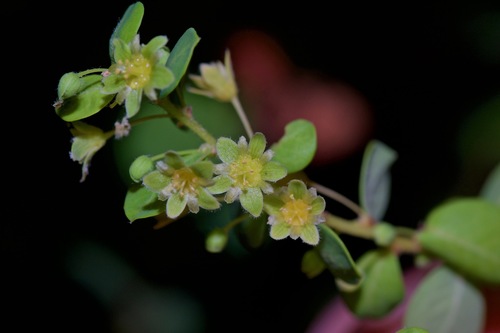


Maidenbush
phyllanthopsis phyllanthoides
Maidenbush (Phyllanthopsis phyllanthoides) is a charming, deciduous shrub native to the south-central United States. Tucked away in rocky glades and limestone bluffs, this resilient plant stands out for its delicate, branching structure and intricate, small leaves. While it may not boast flamboyant blooms, its subtle, greenish-yellow flowers play a quiet yet vital role in supporting local pollinators, making it an understated but ecologically important species in its native environment.
Habitat: Typically found in limestone glades, rocky bluffs, barrens, and open oak-juniper woodlands with thin, calcareous soils.
This low-growing, multi-branched shrub typically reaches heights of 30 to 100 centimeters. It features slender, reddish-brown to grayish stems adorned with small, alternate, obovate to elliptic green leaves about 1 to 3 centimeters long. In late spring and summer, it produces tiny, inconspicuous pale greenish-yellow flowers that lack petals and are clustered in the leaf axils, eventually giving way to small, three-lobed seed capsules.
Category
PlantsRarity
Common
Danger
1/5 · Very low
Snaps
Be the first to snap!
Despite its delicate appearance, Maidenbush is extremely tough and can grow directly out of narrow cracks in solid limestone.
Its scientific genus name, Phyllanthopsis, translates to 'resembling Phyllanthus', referencing its close botanical relationship and physical similarity.
The fruits of Maidenbush are explosive; when the seed capsules dry out, they pop open with a distinct clicking sound to fling seeds several feet away.
It has adapted to thrive in highly alkaline, nutrient-poor calcareous soils where many other plant species struggle to survive.
Its small, thick leaves and deep root system help minimize water loss, allowing it to withstand long periods of dry weather.
The mature three-lobed seed capsules dry out and split open forcefully, launching seeds away from the parent plant to colonize new spots.
As a photosynthetic plant, Maidenbush produces its own sugars and energy using sunlight, water, and carbon dioxide.
No trait badges are assigned for this object yet.
No aliases listed yet.
Collections for this object will appear here as more themes are added.
Danger
1/5 · Very low
No special safety notes yet.
Start with the whole plant, then compare leaf arrangement, leaf edges, stems and any flowers or fruit. Opposite leaves grow in pairs; alternate leaves come one at a time along the stem. These details tell you far more together than a single green leaf does. Plant Identifier: upload a photo and compare the visible details.
30-100 cm
5-15 years
As a photosynthetic plant, Maidenbush produces its own sugars and energy using sunlight, water, and carbon dioxide.
Typically found in limestone glades, rocky bluffs, barrens, and open oak-juniper woodlands with thin, calcareous soils.
Zoom in to split clusters and explore where this object has been snapped.
Recent snaps will appear here as new observations are added.
Take the discovery with you
Snap it with Snappit to identify it, learn what makes it special, and add the discovery to your collection.


















