

Mandrill
mandrillus sphinx
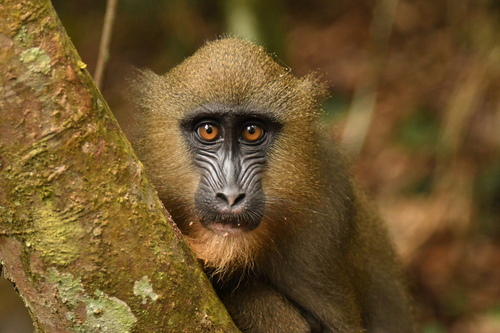
The mandrill is an extraordinary primate and the largest of all monkey species. Recognized for its breathtaking and vibrant coloration, this highly social species lives in the dense rainforests of equatorial Africa. Mandrills exhibit extreme sexual dimorphism; mature males are nearly twice the size of females and boast incredibly vivid red and blue facial and rear markings. These primates are highly terrestrial, spending their days foraging on the forest floor in large family groups called troops or massive aggregations known as hordes, which can number in the hundreds. They play a vital role in their ecosystems as seed dispersers and are a captivating symbol of evolutionary diversity.
Habitat: Found in dense tropical rainforests, riparian gallery forests, and occasionally coastal forests of equatorial Africa.
Adult male mandrills have a striking blue and red ribbed face, a bright yellow beard, and a multi-colored rump of blue, purple, and red. They possess an olive-green to dark grey coat with a pale belly, and a short, stubby tail. Females and juveniles are significantly smaller, lacking the vivid facial ridges and displaying much duller, brownish-grey coloration.
Category
MammalsRarity
Common
Danger
1/5 · Very low
Snaps
Be the first to snap!
An adult male mandrill's canine teeth can grow up to 5 centimeters (2 inches) long, which are as long as those of a lion and are used primarily for self-defense and threat displays.
Mandrills form some of the largest stable social groups of any non-human primate, with 'hordes' occasionally exceeding 800 individuals.
They spend almost their entire day on the ground but climb into the safety of the lower tree canopy every night to sleep away from predators.
Dominant males use the intensity of their facial and rump colors, driven by testosterone, to signal status and defuse physical conflicts before they start.
They feature large, internal cheek pouches that allow them to stuff food away rapidly and retreat to safer, elevated spots to chew and digest.
Mandrills possess a specialized scent gland on their chest, which they rub against tree trunks to chemically communicate their presence and identity.
Mandrills are opportunistic omnivores that actively forage on the forest floor, consuming a vast range of plant matter, fungi, and small animals.
Age differences: Infants nurse exclusively for several months, gradually learning to forage for soft fruits and insects before weaning fully at about one year of age.

Panthera pardus
Leopards are the primary natural predators of mandrills, actively hunting juveniles and adult females in the forest canopy and floor.
Pan troglodytes
They compete directly for fallen fruits, nuts, and foraging territory on the rainforest floor.
No trait badges are assigned for this object yet.
No aliases listed yet.
Collections for this object will appear here as more themes are added.
Danger
1/5 · Very low
No special safety notes yet.
Compare ears, muzzle, tail, feet and coat markings. Size is hard to judge without something nearby for scale, and young mammals may not have adult coloring yet. Mammal Identifier: upload a photo and compare the visible details.
55+ cm
11+ kg
20+ years
40 km/h
Mandrills are opportunistic omnivores that actively forage on the forest floor, consuming a vast range of plant matter, fungi, and small animals.
Found in dense tropical rainforests, riparian gallery forests, and occasionally coastal forests of equatorial Africa.
Foraging
Zoom in to split clusters and explore where this object has been snapped.
Recent snaps will appear here as new observations are added.

Illinois, US
You might spot Southern White Rhinoceros and Reticulated Giraffe.
View guide →

Massachusetts, US
You might spot African Lion, Tiger, and Southern White Rhinoceros.
View guide →

Arizona, US
You might spot Giraffes, African Lion, and Bornean Orangutan.
View guide →

Michigan, US
You might spot Tiger, Red Panda, and Snow Leopard.
View guide →
Take the discovery with you
Snap it with Snappit to identify it, learn what makes it special, and add the discovery to your collection.