
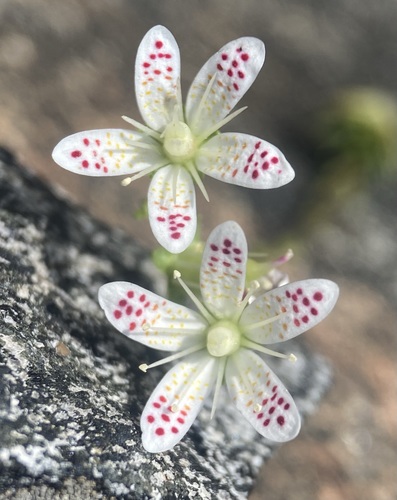


Mat Saxifrage
saxifraga bronchialis
Mat Saxifrage (Saxifraga bronchialis) is a resilient, evergreen perennial plant that forms dense, low-growing, cushion-like mats across alpine and subalpine environments. Perfectly adapted to the harsh conditions of high altitudes and rocky scree slopes, this hardy survivor brightens rugged mountain landscapes with its tiny, star-like flowers. Belonging to the Saxifragaceae family, its genus name literally translates to "stone-breaker," hinting at its ability to thrive in narrow rock crevices where few other plants can take root. This petite plant plays a vital ecological role by stabilizing fragile alpine soils and providing critical nectar sources for high-altitude pollinators.
Habitat: Found on rocky alpine slopes, talus crevices, gravelly tundra, and cliffs at high elevations, typically in cold, exposed environments.
Mat Saxifrage forms low, moss-like mats reaching 5 to 15 centimeters in height. Its small, stiff, linear-lanceolate leaves are closely overlapping, green, and distinctive for the stiff bristles or hairs along their margins. During the summer, slender, reddish flower stalks emerge to bear loose clusters of star-shaped, five-petaled white or cream-colored flowers. Each petal is decorated with tiny, vibrant spots of orange, yellow, and red, which act as nectar guides for visiting insects.
Category
PlantsRarity
Common
Danger
1/5 · Very low
Snaps
Be the first to snap!
Even under a blanket of winter snow, its evergreen leaves remain green and ready to photosynthesize the moment the snow melts in the spring.
The genus name Saxifraga comes from the Latin words 'saxum' (rock) and 'frangere' (to break), referring to either its ability to grow in cracked rocks or its historic medicinal use to dissolve kidney stones.
The tiny, colorful dots on the white petals are actually functional nectar guides, directing insect pollinators directly to the flower's reproductive organs.
Grows in tightly packed, low-lying mats that trap warmth, shield the inner stems from freezing winds, and effectively reduce moisture loss.
Fringed with tiny, stiff hairs that help trap a boundary layer of humid air around the leaves, reducing transpiration in dry alpine air.
Utilizes a tough, deep-reaching root system to extract minimal water and nutrients from thin soil within cracks in solid rock faces.
Produces energy through photosynthesis using sunlight, water, and carbon dioxide, while absorbing minerals through its specialized root system.
Parnassius phoebus
The Phoebus Parnassian butterfly visits the flowers of Mat Saxifrage to feed on nectar, serving as a primary pollinator in high-altitude habitats.
Ochotona princeps
The American Pika harvests Mat Saxifrage along with other alpine plants to build its winter food caches, known as haypiles.
No trait badges are assigned for this object yet.
No aliases listed yet.
Collections for this object will appear here as more themes are added.
Danger
1/5 · Very low
No special safety notes yet.
Start with the whole plant, then compare leaf arrangement, leaf edges, stems and any flowers or fruit. Opposite leaves grow in pairs; alternate leaves come one at a time along the stem. These details tell you far more together than a single green leaf does. Plant Identifier: upload a photo and compare the visible details.
5-15 cm
5-20 years
Produces energy through photosynthesis using sunlight, water, and carbon dioxide, while absorbing minerals through its specialized root system.
Found on rocky alpine slopes, talus crevices, gravelly tundra, and cliffs at high elevations, typically in cold, exposed environments.
Photosynthesis
Zoom in to split clusters and explore where this object has been snapped.
Recent snaps will appear here as new observations are added.

Montana, US
You might spot Bighorn Sheep and Mountain Goat.
View guide →

Montana, US
You might spot Black Bear, Brown Bear, and Moose.
View guide →

Colorado, US
You might spot Rainbow Trout, Brown Trout, and Red Fox.
View guide →
British Columbia, CA
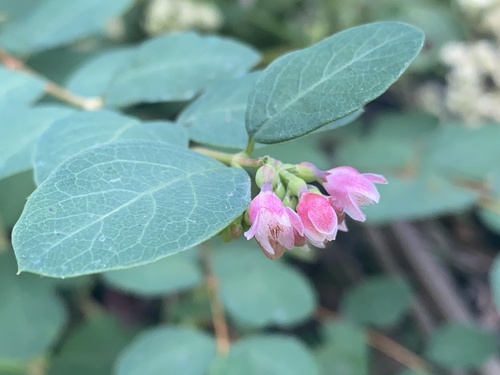
You might spot Common Snowberry and Mat Saxifrage.
View guide →
Take the discovery with you
Snap it with Snappit to identify it, learn what makes it special, and add the discovery to your collection.

















