
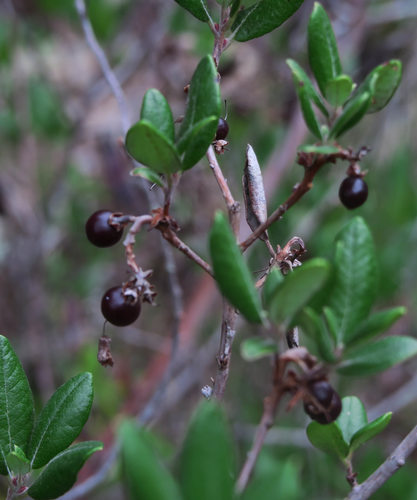


Mission Manzanita
xylococcus bicolor
The Mission Manzanita (Xylococcus bicolor) is a robust evergreen shrub native to the coastal chaparral of Southern California and northern Baja California. It stands out in its dry, sun-drenched habitat as a vital sanctuary and food source for local wildlife. While it closely resembles the common manzanitas of the genus Arctostaphylos, it is the sole species in its own genus, Xylococcus, making it a unique evolutionary relic of the region's botanical history. Its resilience to wildfires and drought highlights the fascinating survival strategies of Mediterranean-climate plants.
Habitat: Found in dry coastal sage scrub, chaparral slopes, and low-elevation foothills below 800 meters, typically growing in sandy or rocky soils.
This woody shrub typically grows between 1.5 and 3 meters tall, featuring a dense, rounded form with shreddy, gray-brown bark on older branches and reddish twigs on new growth. Its leathery, dark-green leaves are highly distinctive: they are glossy on top with margins that roll tightly downward, revealing a contrasting, pale, felt-like white underside. In late winter and early spring, it produces clusters of hanging, urn-shaped flowers that range in color from white to delicate pink, which eventually develop into glossy, dark red-to-black woody berries.
Category
PlantsRarity
Common
Danger
1/5 · Very low
Snaps
Be the first to snap!
Historically, local indigenous peoples like the Kumeyaay used the plant's dense, hard wood to manufacture heavy-duty digging sticks and cooking utensils.
The genus name Xylococcus translates to 'wood berry' in Greek, describing the exceptionally hard, bone-like seed pocket found inside its fleshy fruits.
Unlike true manzanitas of the genus Arctostaphylos, which typically feature smooth, reddish bark, the Mission Manzanita develops a rough, grey-brown, shredding bark with age.
It possesses a woody, underground lignotuber that allows the plant to quickly sprout new green shoots and regenerate after its above-ground foliage is consumed by wildfire.
The leaves feature strongly curled edges and a hairy, light-reflecting underside to reduce moisture loss and protect stomata from the hot, dry winds.
It partners with specialized mycorrhizal fungi in the soil, enhancing its ability to extract water and essential nutrients from nutrient-poor, rocky terrains.
The Mission Manzanita is a self-sustaining plant that generates its own energy through photosynthesis, converting sunlight, carbon dioxide, and water into sugars.

Callipepla californica
The California Quail feeds extensively on the fallen dry berries of the shrub, seeking cover beneath its dense canopy.
Bombus vosnesenskii
The Yellow-faced Bumblebee visits the winter blooms to collect nectar, acting as a crucial pollinator for the plant.

Odocoileus hemionus
Mule deer occasionally browse the evergreen foliage during dry autumn periods when other food sources are scarce.
No trait badges are assigned for this object yet.
No aliases listed yet.
Collections for this object will appear here as more themes are added.
Danger
1/5 · Very low
No special safety notes yet.
Start with the whole plant, then compare leaf arrangement, leaf edges, stems and any flowers or fruit. Opposite leaves grow in pairs; alternate leaves come one at a time along the stem. These details tell you far more together than a single green leaf does. Plant Identifier: upload a photo and compare the visible details.
150-300 cm
50-150 years
The Mission Manzanita is a self-sustaining plant that generates its own energy through photosynthesis, converting sunlight, carbon dioxide, and water into sugars.
Found in dry coastal sage scrub, chaparral slopes, and low-elevation foothills below 800 meters, typically growing in sandy or rocky soils.
Zoom in to split clusters and explore where this object has been snapped.
Recent snaps will appear here as new observations are added.
Take the discovery with you
Snap it with Snappit to identify it, learn what makes it special, and add the discovery to your collection.


















