
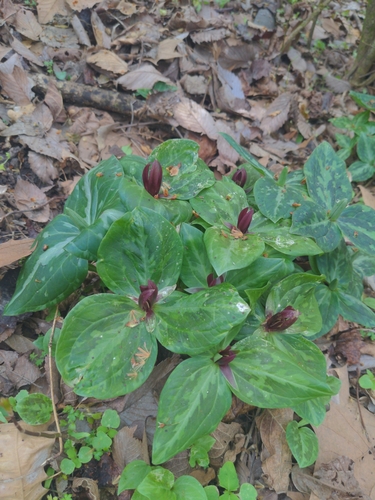


Mississippi River Wakerobin
trillium foetidissimum
The Mississippi River Wakerobin, Trillium foetidissimum, is a captivating perennial wildflower endemic to the floodplains and terraces of the lower Mississippi River valley. This distinctive member of the Trillium genus is cherished by botanists and nature enthusiasts for its unique appearance and ecological adaptations. It is an early spring bloomer, signaling the arrival of warmer weather in its woodland habitat. Its name, 'foetidissimum,' hints at a less appealing characteristic – a subtle, musky scent that plays a crucial role in its reproductive strategy. Despite its odor, this wakerobin is a resilient and integral component of the rich biodiversity found in its specific geographic range, often found thriving in areas where other plants might struggle.
Habitat: Found in rich, moist deciduous woodlands, particularly on floodplains, terraces, and calcareous soils along the Mississippi River and its tributaries.
This Trillium typically features a single, erect stem rising from an underground rhizome, topped by a whorl of three distinctive, broad, dark green leaves that are often mottled with lighter green or purple patterns. Above the leaves, a solitary, stalkless (sessile) flower emerges. The petals are deep reddish-brown to maroon, sometimes appearing almost black, and are erect or slightly recurved, giving the flower a distinctive, somewhat brooding appearance. The flower size is moderate, typically around 3-5 cm across, nestled directly at the junction of the three leaves.
Category
PlantsRarity
Common
Danger
1/5 · Very low
Snaps
Be the first to snap!
It is a relatively long-lived plant, with individuals capable of surviving for several decades, growing slowly from its underground rhizome.
Like many Trillium species, the Mississippi River Wakerobin is an 'ant plant,' relying on ants to disperse its seeds, a process known as myrmecochory.
The plant's mottled leaves provide excellent camouflage on the dappled forest floor, making it blend in with leaf litter and shadows.
The specific epithet 'foetidissimum' is Latin for 'most foul-smelling,' referring to the subtle musky odor of its flowers, which attracts its insect pollinators.
The Mississippi River Wakerobin produces seeds with a fleshy, lipid-rich appendage called an elaiosome, which attracts ants. Ants collect the seeds, carry them to their nests, consume the elaiosome, and discard the intact seed, aiding in dispersal away from the parent plant.
Its reddish-brown, sessile flowers emit a faint, musky or 'foetid' odor, mimicking decaying organic matter. This scent attracts various species of flies and beetles, which act as primary pollinators for the plant, transferring pollen as they investigate the flower.
Growing from a robust underground rhizome, this perennial plant can persist for many decades. This allows it to store energy, withstand environmental fluctuations, and resprout reliably each spring, even after disturbance to its above-ground parts.
As a photosynthetic plant, the Mississippi River Wakerobin produces its own food through photosynthesis, converting sunlight, carbon dioxide, and water into sugars. It absorbs essential minerals and water from the soil through its extensive root system and symbiotic relationships.
Various Formicidae species
Seed dispersal by carrying elaiosome-rich seeds to their nests.
Various Calliphoridae/Sarcophagidae species
Pollination of flowers by visiting for nectar/scent and transferring pollen.

Odocoileus virginianus
Consuming leaves, stems, or flowers, potentially impacting plant reproduction and survival.

Various Glomeromycota species
Forms a symbiotic relationship with roots, enhancing nutrient and water absorption.
No trait badges are assigned for this object yet.
No aliases listed yet.
Collections for this object will appear here as more themes are added.
Danger
1/5 · Very low
No special safety notes yet.
Start with the whole plant, then compare leaf arrangement, leaf edges, stems and any flowers or fruit. Opposite leaves grow in pairs; alternate leaves come one at a time along the stem. These details tell you far more together than a single green leaf does. Plant Identifier: upload a photo and compare the visible details.
15-40 cm
0.01-0.05 kg
15-30 years
As a photosynthetic plant, the Mississippi River Wakerobin produces its own food through photosynthesis, converting sunlight, carbon dioxide, and water into sugars. It absorbs essential minerals and water from the soil through its extensive root system and symbiotic relationships.
Found in rich, moist deciduous woodlands, particularly on floodplains, terraces, and calcareous soils along the Mississippi River and its tributaries.
Photosynthesis And Nutrient Absorption
20-100
Zoom in to split clusters and explore where this object has been snapped.
Recent snaps will appear here as new observations are added.
Take the discovery with you
Snap it with Snappit to identify it, learn what makes it special, and add the discovery to your collection.


















