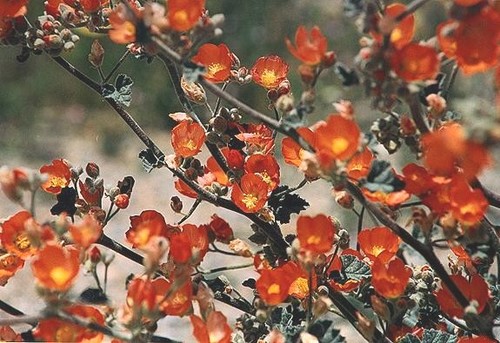


Munro'S Globemallow
sphaeralcea munroana
Munro's globemallow (Sphaeralcea munroana) is an eye-catching perennial wildflower native to the arid and semi-arid regions of western North America. Thriving in the rugged sagebrush steppes and dry valleys, this hardy member of the mallow family stands out with its upright clumps of bright, apricot-orange blossoms that bring a splash of brilliant color to dry landscapes. It is highly valued not only for its striking beauty but also for its exceptional drought tolerance and ecological role in supporting native pollinators. With deeply lobed, fuzzy gray-green leaves, Munro's globemallow is perfectly adapted to survive under the intense summer sun. Its deep root system allows it to stabilize soils and prevent erosion, making it an excellent pioneer species in disturbed soils and post-wildfire recovery zones.
Habitat: Typically found in dry, open habitats including sagebrush steppes, pinyon-juniper woodlands, and desert valleys, often thriving in sandy or gravelly soils.
This species grows in clustered, erect stems reaching 20 to 80 cm in height. The most prominent feature is its five-petaled, bowl-shaped flowers, which range in color from a pale orange to a vivid reddish-apricot, arranged in dense terminal spikes. Its leaves are alternate, wedge-shaped to rounded, and deeply divided into three to five lobes. The entire plant, especially the foliage, is covered in a dense coat of fine, star-shaped (stellate) hairs, giving the leaves a distinctive velvety, grayish-green texture that helps identify it in the wild.
Category
PlantsRarity
Common
Danger
1/5 · Very low
Snaps
1
Due to its exceptional ability to bind loose soil and rapidly sprout after disturbances, it is frequently used by land managers for post-wildfire re-seeding and erosion control.
Its vibrant orange petals were historically used by some Native American tribes to create natural dyes, and the roots were sometimes prepared into poultices for medicinal use.
The fine, star-shaped hairs on its leaves can easily detach and cause significant irritation to the eyes of both humans and animals, earning it the colloquial name 'sore-eye poppy' in some regions.
It possesses a deep, woody taproot that penetrates far into dry soils to access deep-seated water reserves, ensuring survival during dry summer months.
The leaves are covered in dense, star-shaped hairs that reflect excess sunlight, reduce wind-induced moisture loss, and discourage herbivores from feeding.
The plant can readily sprout from its underground caudex after wildfires, allowing it to rapidly colonize and stabilize burned landscapes.
As a photoautotrophic plant, Munro's globemallow synthesizes its own food using sunlight, water, carbon dioxide, and essential nutrients absorbed from the soil.
Diadasia diminuta
Serves as an essential pollen and nectar source for specialized native bees, which help cross-pollinate the flowers.

Pyrgus communis
The foliage acts as a primary larval host plant for the caterpillars of this widespread butterfly species.

Ovis canadensis
Its leaves and stems are occasionally browsed by native wild sheep and goats in arid rocky regions.
No trait badges are assigned for this object yet.
No aliases listed yet.
Collections for this object will appear here as more themes are added.
Danger
1/5 · Very low
No special safety notes yet.
The easiest way to identify Munro'S Globemallow is to use the Snappit nature identifier app.
20-80 cm
3-10 years
As a photoautotrophic plant, Munro's globemallow synthesizes its own food using sunlight, water, carbon dioxide, and essential nutrients absorbed from the soil.
Typically found in dry, open habitats including sagebrush steppes, pinyon-juniper woodlands, and desert valleys, often thriving in sandy or gravelly soils.
Photosynthesis
Zoom in to split clusters and explore where this object has been snapped.
Take the discovery with you
Snap it with Snappit to identify it, learn what makes it special, and add the discovery to your collection.












.jpg&width=800)



_001.jpg&width=800)




