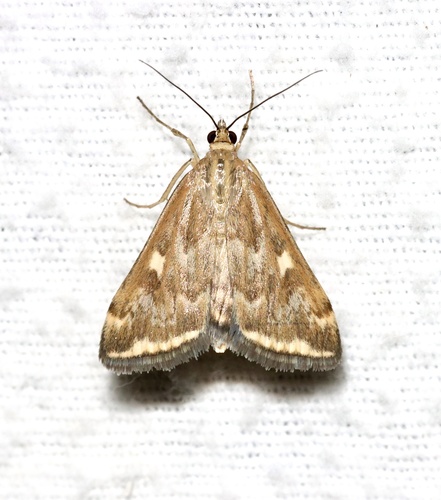


Nearctic Beet Webworm
loxostege munroealis
The Nearctic Beet Webworm (Loxostege munroealis) is an intriguing crambid snout moth native to North America. Often found fluttering in grasslands, agricultural fields, and disturbed sandy areas, this species plays a quiet but significant role in its ecosystem. While the adults serve as nocturnal pollinators, the caterpillar stage is an active herbivore that feeds on a variety of low-growing weeds and crops. Their ability to thrive in modified landscapes highlights their ecological resilience and adaptability. Often overlooked due to their small size, these moths showcase beautiful intricate patterns under close inspection and are highly successful survivalists in temperate zones. For nature enthusiasts, observing their rapid, erratic flight patterns when disturbed during the day provides an engaging look into the hidden micro-fauna of meadows and fields.
Habitat: Found in open grasslands, agricultural fields, prairies, and disturbed weedy areas where herbaceous host plants are abundant.
Adults of this species are small moths with a wingspan ranging from 1.8 to 2.4 centimeters. They have characteristically triangular forewings with a base color of pale yellowish-tan or straw-brown, decorated with intricate wavy brown lines and fine dark spots near the margins. The hindwings are a lighter, semi-translucent grayish-white color with slightly darker edges. When resting, they hold their wings flat in a distinct delta shape, and their elongated labial palps project forward from the head like a small snout, a classic visual marker of the snout moth family.
Category
InsectsRarity
Common
Danger
1/5 · Very low
Snaps
3
The name 'snout moth' comes from their prominent mouthparts, which project forward like a beak.
Their caterpillars are known to build complex silken tubes at the base of plants to hide from ground-dwelling predators.
While they are minor agricultural pests in high numbers, they serve as an invaluable protein source for nesting songbirds in the spring.
Adult moths possess coloring that mimics dried leaves and grasses, allowing them to remain completely hidden on the ground during the day.
Caterpillars spin protective silk webs over host leaves to shield themselves from predators and harsh weather while feeding.
Equipped with abdominal tympanic organs, these moths can hear the echolocation of bats and initiate evasive diving maneuvers.
The caterpillars are voracious folivores eating herbaceous plants, while the adult moths feed on floral nectar.
Chenopodium album
Host plant for the larval feeding and development stages.
Araneus diadematus
Preys on both the larval and adult stages of the moth.
Trichogramma minutum
A tiny wasp that parasitizes the eggs of the moth, controlling its population.
No trait badges are assigned for this object yet.
No aliases listed yet.
Collections for this object will appear here as more themes are added.
Danger
1/5 · Very low
No special safety notes yet.
The easiest way to identify Nearctic Beet Webworm is to use the Snappit nature identifier app.
1-2 cm
2-3 cm
0.0001-0.0003 kg
1 years
12 km/h
The caterpillars are voracious folivores eating herbaceous plants, while the adult moths feed on floral nectar.
Found in open grasslands, agricultural fields, prairies, and disturbed weedy areas where herbaceous host plants are abundant.
Zoom in to split clusters and explore where this object has been snapped.
Take the discovery with you
Snap it with Snappit to identify it, learn what makes it special, and add the discovery to your collection.













.jpg&width=800)




