



Nemognatha scutellaris
Nemognatha scutellaris
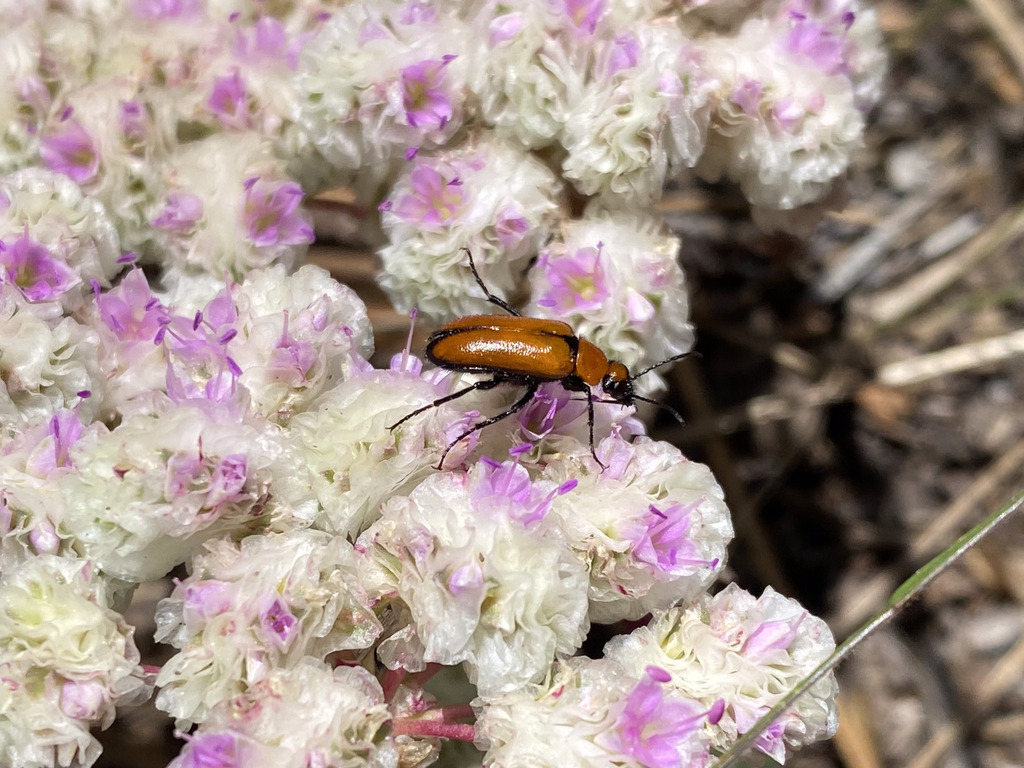
The Nemognatha scutellaris is a special kind of beetle with a shiny, colorful body. It loves to hide in flowers and is often found in gardens, making it a fun little friend to spot while exploring nature!
Habitat: Gardens
The Nemognatha scutellaris has a distinctive, long, snorkel-like proboscis extending from its head. Its body often shows an orange-yellow head and thorax, with contrasting black wing covers and a black scutellum, making it visually stand out on flowers.
Category
InsectsRarity
Common
Danger
1/5 · Very low
Snaps
Be the first to snap!
It belongs to a family of beetles called 'blister beetles'!
The larvae are masters of sneaking into bee nests!
They often look like other insects to trick predators.
This beetle has a mouthpart longer than its head!
Nemognatha scutellaris has a super long proboscis that helps them reach deep nectar in tubular flowers, giving them access to special food.
Nemognatha scutellaris larvae can hitch a ride on unsuspecting bees because this strategy helps them find a safe nursery and food supply.
Nemognatha scutellaris can often mimic bees in appearance and movement, which helps them avoid predators.
Adults sip sweet nectar and munch on pollen from flowers, but larvae feast on bee provisions!
Age differences: Larvae (triungulins) are parasitic, seeking out bee nests to feed on their stored pollen and sometimes the bee larvae or eggs.

Helianthus annuus
Adults feed on its nectar and pollen.
Andrena erythrogastra
Larvae develop in its nest, consuming provisions.
Solidago canadensis
Provides nectar and pollen for adults.
Solitary animals live alone for most of their lives, only interacting with others for mating or parental care.
Colorful describes organisms or objects displaying a wide range of bright and distinct colors.
This trait characterizes organisms whose diet consists entirely or primarily of plant material.
Describes plants that are particularly attractive and beneficial to a wide range of pollinating organisms.
Diurnal animals are primarily active during daylight hours, typically resting or sleeping at night.
This habitat trait indicates species that can coexist with humans in urban and suburban environments, utilizing man-made structures and green spaces.
Describes organisms that transfer pollen, enabling the fertilization and reproduction of plants.
No aliases listed yet.
Danger
1/5 · Very low
Be gentle and watch where you step when exploring gardens to protect tiny creatures.
Look for hard wing covers meeting in a line down the back, then compare the antennae, body shape, legs and markings. Metallic colors shift a lot with lighting. Beetle Identifier: upload a photo and compare the visible details.
12-24 mm
6-12 mm
20-40 days
Adults sip sweet nectar and munch on pollen from flowers, but larvae feast on bee provisions!
Gardens
6
Zoom in to split clusters and explore where this object has been snapped.
Recent snaps will appear here as new observations are added.
Take the discovery with you
Snap it with Snappit to identify it, learn what makes it special, and add the discovery to your collection.