





Sunflower
Helianthus annuus
Sunflowers are tall, bright flowers that follow the sun from sunrise to sunset. Their seeds are tasty and loved by birds and squirrels.
Habitat: Grasslands
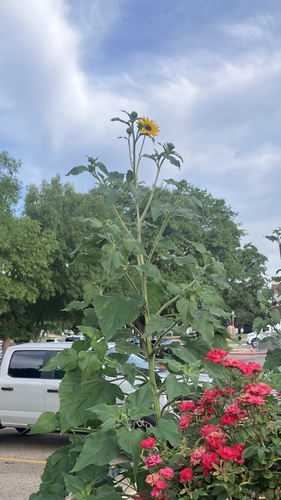
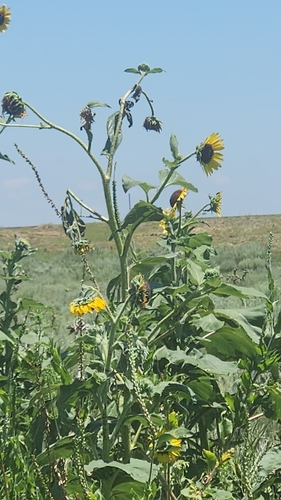
The Sunflower has a stout, hairy stem topped by a single, large flower head. Its vibrant yellow ray petals encircle a dense disc of tiny dark brown or purplish florets. It stands tall, often much taller than a person.
Category
PlantsRarity
Common
Danger
1/5 · Very low
Snaps
16
A single sunflower head is actually made of thousands of tiny flowers!
Sunflower oil is used in cooking and even to make biodiesel fuel for cars!
The pattern of seeds in a sunflower often follows a special math spiral called Fibonacci.
The tallest sunflower ever recorded grew over 9 meters (30 feet) tall!
Sunflower can turn its head to follow the sun across the sky, helping it warm up faster and attract more pollinators.
Sunflower has a gigantic head packed with hundreds of seeds, which helps it reproduce many new plants.
Sunflower can absorb harmful toxins like lead from the soil, helping to clean up polluted land.
Apis mellifera
Visits flowers to collect nectar and pollen.
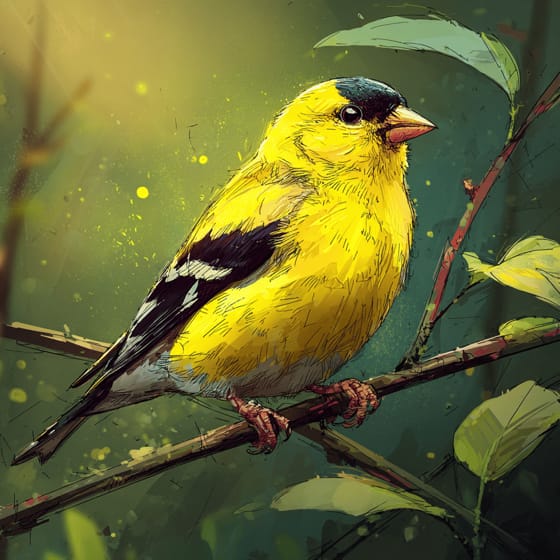
Spinus tristis
Feeds on ripe sunflower seeds in late summer and fall.

Homo sapiens
Cultivates sunflowers for edible seeds and oil production.
Annual plants complete their entire life cycle, from germination to seed production, within a single growing season.
Herbaceous plants are non-woody plants with soft stems that typically die back to the ground at the end of the growing season.
Flowering plants are any plants that produce flowers as part of their reproductive cycle.
Ornamental plants are cultivated primarily for their aesthetic appeal, enhancing landscapes and gardens with their attractive foliage, flowers, or form.

Shade tolerant plants are adapted to grow and thrive in areas with low light levels, requiring less direct sunlight.

Summer blooming plants produce their flowers during the summer season, often providing vibrant color when many other plants have finished.

Fruit-bearing plants produce fruits, which are the mature ovaries of flowering plants containing seeds.

This human use trait identifies species cultivated as oil crops, harvested for their seeds or fruits from which vegetable oils are extracted for food, fuel, or industrial uses.

Edible plants are those parts of a plant that are considered safe for human consumption.

Grassland habitats are terrestrial biomes dominated by grasses and herbaceous plants, supporting a variety of grazing animals.

Describes plants that are particularly attractive and beneficial to a wide range of pollinating organisms.

Rapid growing plants exhibit accelerated growth rates, quickly increasing in size and biomass within a short period.

This trait signifies organisms belonging to a very old evolutionary group with ancestors dating back millions of years.
Danger
1/5 · Very low
Enjoy the beauty of sunflowers from a safe distance and avoid picking them in the wild.
The easiest way to identify Sunflower is to use the Snappit nature identifier app.
150-400 cm
30-60 cm
10-30 cm
Summer to early fall
Yes
None
Annual
Zoom in to split clusters and explore where this object has been snapped.
Jun 3, 2026
Cameron Park ZooPhoto attribution
(c) Melissa Mullins, some rights reserved (CC BY)
License: CC BY 4.0 ↗
Image may be shown cropped inside the card frame.

Texas, US
You might spot Eastern Fox Squirrel and Great-Tailed Grackle.
View guide →

California, US
You might spot Sunburst Anemone, Ochre Sea Star, and Striped Shore Crab.
View guide →

Texas, US
You might spot Brown Anole, Gulf Fritillary, and Pond Slider.
View guide →

Nebraska, US
You might spot Showy Milkweed and Straight-Lined Wave.
View guide →

New Mexico, US
You might spot Sunflower, Sideoats Grama, and Tree Cholla.
View guide →

Texas, US
You might spot African Elephant, Reticulated Giraffe, and African Lion.
View guide →
Take the discovery with you
Snap it with Snappit to identify it, learn what makes it special, and add the discovery to your collection.








.jpg&width=800)



_001.jpg&width=800)


