

Neotredecim Periodical Cicada
magicicada neotredecim
The Neotredecim Periodical Cicada is a remarkable insect famed for its highly synchronized, 13-year lifecycle. Discovered as a distinct species in the year 2000, it closely resembles its 17-year relative but emerges on a shorter cycle across the Midwestern and South-Central United States. Spending over a decade underground as nymphs feeding on tree roots, millions of these cicadas emerge simultaneously to molt into adults, mate, and lay eggs over a frantic few weeks. This mass emergence strategy, known as predator satiation, overwhelms local predators with sheer numbers, ensuring the survival of the next generation. Their deafening choruses transform quiet forests into a buzzing spectacle of sound and life.
Habitat: Found in mature deciduous forests, woodlands, and urban parks with abundant mature trees across the central United States.
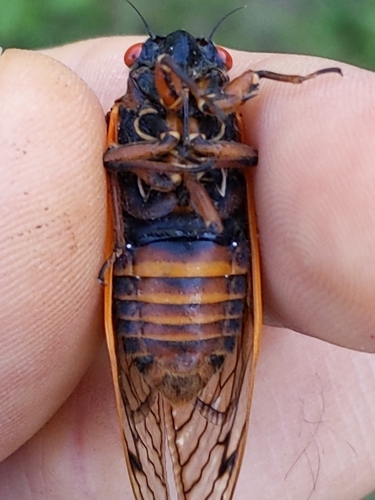
Adults are striking insects characterized by a stout, pitch-black dorsal body, vivid red eyes, and translucent wings laced with distinct orange or amber veins. The underside of the abdomen features bold orange stripes, which helps distinguish them from closely related species. They possess a characteristic wide head, short antennae, and a prominent beak-like rostrum used for piercing plant tissue. Measuring around 1 to 1.5 inches in length, their wingspan extends considerably past the abdomen when at rest.
Category
InsectsRarity
Common
Danger
1/5 · Very low
Snaps
Be the first to snap!
Despite living for 13 years, the adult cicadas only survive for about 2 to 4 weeks above ground to mate and lay eggs.
Magicicada neotredecim was only described as a distinct species in 2000, differentiated from other 13-year cicadas by the pitch of its mating song.
To survive, they rely on predator satiation, emerging in such massive numbers that every predator gets full, leaving millions of cicadas untouched.
When infected by the Massospora fungus, their abdomens fall off and are replaced by a fungal plug, which they actively spread while attempting to mate.
Millions of nymphs emerge simultaneously every 13 years to overwhelm predators in a strategy called predator satiation.
Males possess specialized ribbed structures called tymbals on their abdomens, which they rapidly vibrate to produce a deafening mating call.
Both nymphs and adults use a specialized piercing-sucking rostrum to extract dilute, nutrient-poor fluids from the xylem of host trees.
Nymphs feed on the sap of tree roots underground for 13 years, while adults occasionally feed on fluids from twigs and small branches.
Age differences: Nymphs feed exclusively on underground roots, while the short-lived adults feed very little, occasionally sipping from above-ground branches.

Quercus alba
Host plant for feeding and egg-laying.
Turdus migratorius
Preyed upon extensively during mass emergences.
Massospora cicadina
Infected by a specialized pathogenic fungus.
Sphecius speciosus
Hunted by specialized wasps.
No trait badges are assigned for this object yet.
No aliases listed yet.
Collections for this object will appear here as more themes are added.
Danger
1/5 · Very low
No special safety notes yet.
Look for six legs, antennae, three body sections and the shape of the wings. Beetles have hardened front wings; flies have just one working pair. Tiny insects may need a close view before their group is clear. Insect Identifier: upload a photo and compare the visible details.
2-4 cm
7-8 cm
0.001-0.003 kg
13 years
Nymphs feed on the sap of tree roots underground for 13 years, while adults occasionally feed on fluids from twigs and small branches.
Found in mature deciduous forests, woodlands, and urban parks with abundant mature trees across the central United States.
Foraging
Zoom in to split clusters and explore where this object has been snapped.
Recent snaps will appear here as new observations are added.
Take the discovery with you
Snap it with Snappit to identify it, learn what makes it special, and add the discovery to your collection.