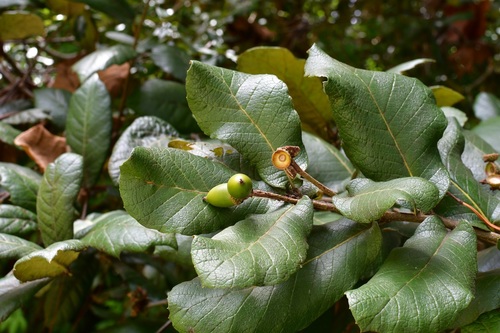


Netleaf Oak
quercus rugosa
The Netleaf Oak (Quercus rugosa) is a hardy, evergreen tree or shrub native to the highlands of Mexico and the southwestern United States. Thriving in mountainous oak-pine woodlands and rocky canyon slopes, this oak is highly valued for its ecological contributions. It provides high-quality food in the form of acorns and reliable nesting shelter for many montane birds and mammals. Its ability to tolerate rocky, nutrient-poor soils and long periods of drought makes it a tough survivor in challenging climates, where it can grow either as a multi-stemmed shrub or a single, robust canopy tree.
Habitat: Typically found in mountainous oak-pine woodlands and canyon slopes at elevations between 1,000 and 3,000 meters.
This oak is easily recognized by its thick, leathery, spoon-shaped leaves that have margins curled distinctly downward. The upper leaf surfaces are a deep, glossy green with a dramatic net-like pattern of sunken veins, giving them a heavily wrinkled appearance, while the undersides are covered in dense, amber to rust-colored hairs. Its bark is thick, rugged, and dark brown or gray with deep fissures. During autumn, it produces narrow, elongated acorns about 1.5 to 2.5 centimeters long, hanging from unusually long stalks in pairs or small clusters.
Category
PlantsRarity
Common
Danger
1/5 · Very low
Snaps
1
Its leaves are exceptionally durable and can remain attached to the branches for up to three years before falling.
The heavy, dense wood of this oak has historically been used in Mexico to produce high-grade charcoal and durable tool handles.
The specific epithet 'rugosa' comes from the Latin word for wrinkled, highlighting the deeply textured, net-like veins on its leaves.
The thick, deeply wrinkled leaves are coated in amber hairs on the underside to trap moisture, significantly reducing water loss during dry spells.
Following damage from forest fires, this plant can vigorously resprout from its underground root crown or lignotuber.
It partners with underground symbiotic fungi to extract scarce moisture and essential minerals from extremely rocky soils.
As a photoautotroph, the Netleaf Oak converts solar energy into food through photosynthesis, utilizing sunlight, carbon dioxide, water, and soil minerals.

Melanerpes formicivorus
The acorns of the Netleaf Oak are a primary autumn and winter food source for this bird.
Hypaurotis crysalus
Acts as a larval host plant, where caterpillars feed on the tough foliage.

Amanita muscaria
Forms a mutualistic mycorrhizal relationship with the tree's root system to exchange water and soil nutrients for sugars.
No trait badges are assigned for this object yet.
No aliases listed yet.
Collections for this object will appear here as more themes are added.
Danger
1/5 · Very low
No special safety notes yet.
Start with the whole plant, then compare leaf arrangement, leaf edges, stems and any flowers or fruit. Opposite leaves grow in pairs; alternate leaves come one at a time along the stem. These details tell you far more together than a single green leaf does. Plant Identifier: upload a photo and compare the visible details.
200-1500 cm
100-5000 kg
100-300 years
As a photoautotroph, the Netleaf Oak converts solar energy into food through photosynthesis, utilizing sunlight, carbon dioxide, water, and soil minerals.
Typically found in mountainous oak-pine woodlands and canyon slopes at elevations between 1,000 and 3,000 meters.
Photosynthesis
Zoom in to split clusters and explore where this object has been snapped.
Take the discovery with you
Snap it with Snappit to identify it, learn what makes it special, and add the discovery to your collection.