





Acorn Woodpecker
Melanerpes formicivorus
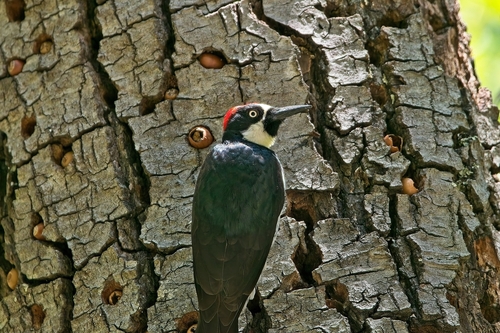
The Acorn Woodpecker is a colorful bird that loves to eat acorns! They are known for their funny, loud calls and their unique habit of storing acorns in holes in trees.
Habitat: Forests
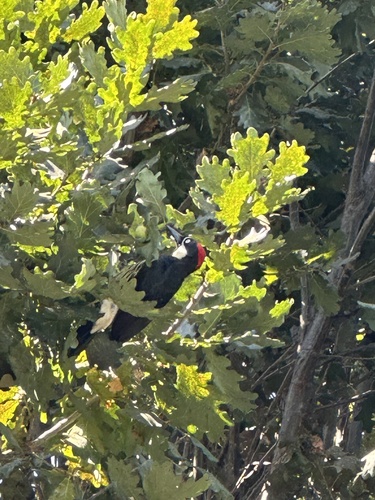
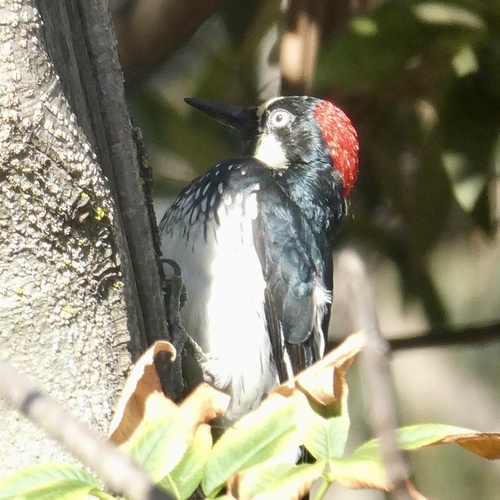
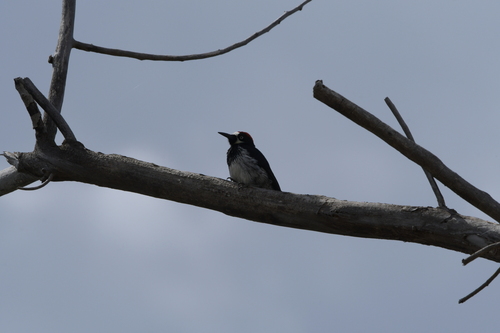
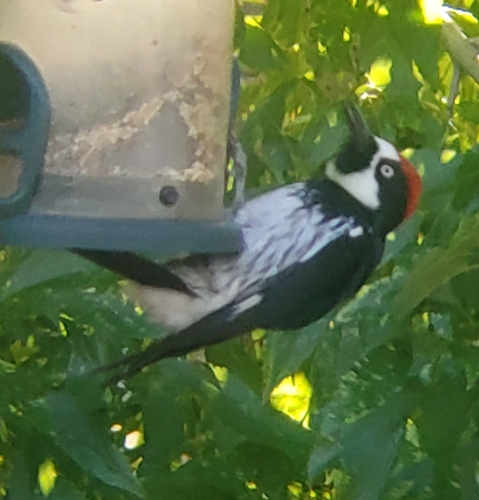
The Acorn Woodpecker has a distinctive black back and white belly, with a white patch around each eye. Its crown is boldly red in males and juveniles, while females have a black band between a red patch and white forehead. These birds are further distinguished by a white rump visible in flight.
Category
BirdsRarity
Common
Danger
1/5 · Very low
Snaps
40
A single granary tree can be used for over 100 years by generations of woodpeckers!
Acorn Woodpecker eggs are laid in a shared nest cavity by multiple females!
The vibrant red on a male's cap indicates his age and social status.
Their unique, barbed tongue can extend far past their beak to snag insects.
Acorn Woodpeckers can raise chicks together because multiple adults, including non-breeding helpers, share nesting duties.
Acorn Woodpecker can snatch insects right out of the air because their keen eyesight and agile flight make them skilled aerial hunters.
These clever birds eat mostly acorns and other nuts, but also enjoy insects, fruits, and tree sap.
Feathered describes animals, primarily birds, possessing a covering of feathers.
Social animals live in organized groups, cooperating for survival benefits such as foraging, defense, and raising offspring.
This trait identifies organisms whose diet includes both plant and animal matter.
Arboreal animals live primarily in trees, utilizing them for shelter, food, and protection from predators.

Colorful describes organisms or objects displaying a wide range of bright and distinct colors.

This trait describes organisms that manipulate external objects to achieve a specific goal.

Forest habitats are terrestrial environments dominated by dense tree cover, supporting a high diversity of plant and animal life.

Diurnal animals are primarily active during daylight hours, typically resting or sleeping at night.

Describes a species whose presence and role have a disproportionately large effect on its environment.
No aliases listed yet.
Danger
1/5 · Very low
Always watch birds from a distance and don't disturb their nests.
The easiest way to identify Acorn Woodpecker is to use the Snappit nature identifier app.
21-23 cm
42-45 cm
0.065-0.085 kg
5-16 years
45 km/h
These clever birds eat mostly acorns and other nuts, but also enjoy insects, fruits, and tree sap.
Forests
Zoom in to split clusters and explore where this object has been snapped.
Jun 18, 2026
Desert Garden ConservatoryPhoto attribution
(c) Adam Petrucco, some rights reserved (CC BY)
License: CC BY 4.0 ↗
Image may be shown cropped inside the card frame.
Jun 5, 2026
Sonoma PlazaPhoto attribution
(c) Daveozric, some rights reserved (CC BY)
License: CC BY 4.0 ↗
Image may be shown cropped inside the card frame.
Jun 2, 2026
Atchison VillagePhoto attribution
(c) Karen Offereins, some rights reserved (CC BY)
License: CC BY 4.0 ↗
Image may be shown cropped inside the card frame.
May 27, 2026
Folsom City Zoo SanctuaryPhoto attribution
(c) Hawk T., some rights reserved (CC BY)
License: CC BY 4.0 ↗
Image may be shown cropped inside the card frame.
May 10, 2026
Madera CanyonPhoto attribution
no rights reserved
License: CC0 1.0 ↗
Image may be shown cropped inside the card frame.

California, US
You might spot Acorn Woodpecker and Western Fence Lizard.
View guide →

California, US
You might spot Western Fence Lizard and California Brittlebush.
View guide →

California, US
You might spot Monarch, Canada Goose, and Western Gull.
View guide →

California, US
You might spot Redwood, Pacific Trillium, and Evergreen Huckleberry.
View guide →

California, US
You might spot Warrior's Plume and Purple Owl's-Clover.
View guide →

California, US
You might spot Monarch, Bee, and Anise Swallowtail.
View guide →
Take the discovery with you
Snap it with Snappit to identify it, learn what makes it special, and add the discovery to your collection.




.jpg&width=800)







