
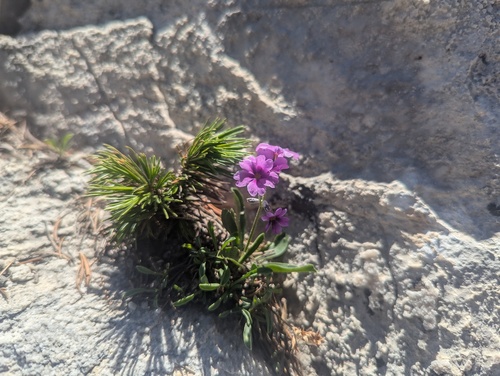


Nevada Primrose
primula nevadensis
The Nevada Primrose (Primula nevadensis) is a rare and resilient alpine jewel, clinging to life in the harsh, windswept high-altitude environments of Nevada's mountain ranges. Found primarily in the limestone crevices and rocky talus of the subalpine and alpine zones, this delicate perennial herb stands out against its rugged terrain. Despite the extreme cold, intense UV radiation, and brief growing seasons of its alpine home, it bursts into beautiful, vibrant color each summer, signaling the brief window of warmth in the high country. Endemic to a few remote mountain ranges in Nevada, such as the Snake Range in Great Basin National Park, this species is a true specialist. Its survival depends on highly specific microhabitats where snow lingers to provide moisture into the dry summer months. For hikers and botanists alike, encountering this small but tenacious wildflower is a rare reward, representing the fragile beauty of North America's Great Basin desert summits.
Habitat: Found in alpine and subalpine zones, clinging to limestone rock crevices, scree slopes, and gravelly ridges at elevations above 3,000 meters.
The Nevada Primrose is a low-growing, perennial herb forming small rosettes of leaves close to the ground, with flowering stems typically reaching only 2 to 10 centimeters in height. Its spatula-shaped leaves are light green, slightly fleshy, and often have finely toothed margins. The most striking feature is its cluster of 1 to 10 tubular flowers, which bloom in shades of lavender, violet, or deep rose-purple. Each flower features five notched petals surrounding a contrasting yellow or white center 'eye,' creating a brilliant beacon for pollinators against the grey limestone backdrop.
Category
PlantsRarity
Common
Danger
1/5 · Very low
Snaps
Be the first to snap!
Its seeds rely on the freeze-thaw cycles of harsh mountain winters to crack open their hard outer coats, a process known as cold stratification.
The Nevada Primrose is a narrow endemic, meaning it is native to only a tiny geographical area on Earth, specifically a few mountain peaks in eastern Nevada.
This hardy plant lives exclusively at extreme elevations, often found clinging to rocky surfaces over 10,000 feet (3,000 meters) above sea level.
Produces specialized cellular compounds that protect its tissues from damage during sudden, freezing alpine nights.
Maintains an exceptionally strong taproot system designed to wedge into micro-fissures in limestone, securing the plant against fierce mountain winds.
Grows in low, compact rosettes that hug the ground, trapping pockets of warmer air and conserving precious moisture.
As a photoautotrophic plant, the Nevada Primrose generates its own food using sunlight, water, and carbon dioxide through the process of photosynthesis.
Bombus huntii
Pollinated by bumblebees seeking nectar in alpine meadows.
Ochotona princeps
American Pikas harvest and store the foliage in haypiles for winter consumption.
Physaria alpestris
Competes for scarce water and root space in rocky limestone crevices.
No trait badges are assigned for this object yet.
No aliases listed yet.
Collections for this object will appear here as more themes are added.
Danger
1/5 · Very low
No special safety notes yet.
Start with the whole plant, then compare leaf arrangement, leaf edges, stems and any flowers or fruit. Opposite leaves grow in pairs; alternate leaves come one at a time along the stem. These details tell you far more together than a single green leaf does. Plant Identifier: upload a photo and compare the visible details.
2-10 cm
0.005-0.02 kg
3-10 years
As a photoautotrophic plant, the Nevada Primrose generates its own food using sunlight, water, and carbon dioxide through the process of photosynthesis.
Found in alpine and subalpine zones, clinging to limestone rock crevices, scree slopes, and gravelly ridges at elevations above 3,000 meters.
Zoom in to split clusters and explore where this object has been snapped.
Recent snaps will appear here as new observations are added.
Take the discovery with you
Snap it with Snappit to identify it, learn what makes it special, and add the discovery to your collection.


















