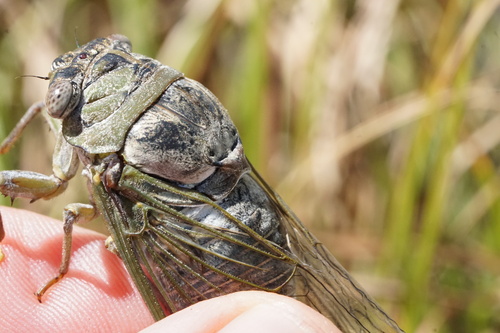


Northern Dusk-Singing Cicada
megatibicen grossus
The Northern Dusk-Singing Cicada, Megatibicen grossus, is one of the most distinctive and widely recognized cicada species in eastern North America. Renowned for its incredibly loud, buzzing, and often pulsing song, it is a quintessential sound of late summer evenings. These fascinating insects spend the vast majority of their lives as nymphs underground, feeding on the sap from tree roots, before emerging as winged adults for a brief but vibrant period of reproduction. Their presence marks the peak of summer, filling the air with their unique calls and serving as a vital part of the ecosystem as both herbivores and a food source for various predators. Its large size and unmistakable song make it a noticeable, if sometimes elusive, inhabitant of temperate forests.
Habitat: Found in deciduous and mixed forests, often near mature trees such as oaks, maples, and elms, where both nymphs and adults can access sap.
This is a large and robust cicada, typically dark in coloration. Its body is predominantly black or very dark brown, often with some lighter, olive-green or brownish markings on the pronotal collar and sometimes on the abdomen. The eyes are usually a striking reddish-brown. Its wings are clear and membranous, with prominent dark veins, and they extend well past the end of the abdomen. The underside may show lighter dusting. The overall impression is one of a powerfully built insect, adapted for strong flight and producing loud vocalizations.
Category
InsectsRarity
Common
Danger
1/5 · Very low
Snaps
Be the first to snap!
Cicada males possess the loudest sound-producing organs of any insect, capable of reaching over 90 decibels.
Female cicadas lay their eggs in small slits they cut into the bark of tree branches, often causing minor damage known as 'flagging' to young twigs.
Its common name, 'Dusk-Singing', refers to its peak singing activity occurring in the late afternoon and evening hours.
The nymphs of this cicada can spend multiple years (2 to 9 years) underground before emerging as adults for a mere few weeks to a month.
Male Northern Dusk-Singing Cicadas produce an exceptionally loud and distinctive buzzing song using specialized organs called tymbals. This powerful acoustic display is primarily used to attract mates, echoing through the summer evenings.
The majority of this cicada's life, typically several years, is spent underground as a nymph. During this phase, it feeds on the sap from tree roots, slowly growing and molting before emerging as an adult.
Both the nymphal and adult stages of Megatibicen grossus are specialized sap-feeders. Nymphs consume root sap, while adults use piercing-sucking mouthparts to extract xylem fluid from tree branches and trunks for hydration and nutrients.
Northern Dusk-Singing Cicadas are sap-feeders, utilizing specialized mouthparts to extract xylem fluid from trees. Nymphs feed on root sap, while adults feed on sap from branches and trunks.
Age differences: Nymphs feed on root sap underground, while adults feed on sap from above-ground woody parts of trees.
Quercus spp.
Provides sap for feeding
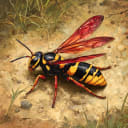
Sphecius speciosus
Predates adult cicadas

Corvus brachyrhynchos
Predates adult cicadas

Procyon lotor
Predates cicada nymphs and adults
No trait badges are assigned for this object yet.
No aliases listed yet.
Collections for this object will appear here as more themes are added.
Danger
1/5 · Very low
No special safety notes yet.
Look for six legs, antennae, three body sections and the shape of the wings. Beetles have hardened front wings; flies have just one working pair. Tiny insects may need a close view before their group is clear. Insect Identifier: upload a photo and compare the visible details.
3-5 cm
8-12 cm
0.005-0.015 kg
2-9 years
Northern Dusk-Singing Cicadas are sap-feeders, utilizing specialized mouthparts to extract xylem fluid from trees. Nymphs feed on root sap, while adults feed on sap from branches and trunks.
Found in deciduous and mixed forests, often near mature trees such as oaks, maples, and elms, where both nymphs and adults can access sap.
Foraging
Zoom in to split clusters and explore where this object has been snapped.
Recent snaps will appear here as new observations are added.
Take the discovery with you
Snap it with Snappit to identify it, learn what makes it special, and add the discovery to your collection.