

Northern Moonsnail
euspira heros
The Northern Moonsnail (Euspira heros) is a remarkably large marine gastropod renowned for its active predatory behavior and impressive size. Dwelling beneath the sandy sediments of the western Atlantic, this snail is famous for its immense, muscular foot which it inflates with seawater to plow through sand in search of prey. It is an essential component of coastal marine food webs, keeping bivalve populations in check.
Habitat: Found in sandy intertidal and subtidal zones of coastal waters, often burying itself just beneath the surface of the sand.
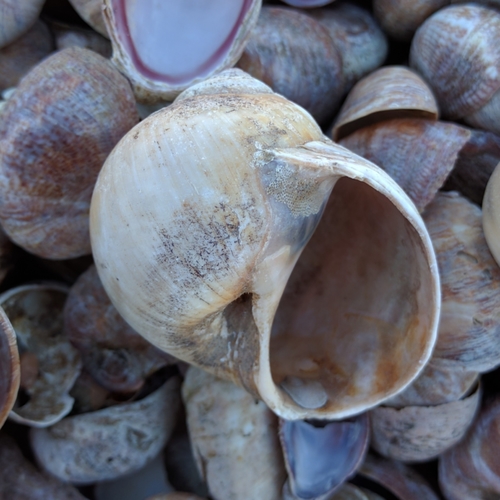
This species possesses a large, smooth, globular shell that can reach up to 14 centimeters in diameter. The shell is typically creamy white, pale grey, or light brownish-grey with a highly expanded body whorl and a short spire. When active, the snail extends a massive, fleshy, translucent-grey foot that can almost completely envelop its shell. It has a tough, leathery, horn-like operculum (trapdoor) used to seal itself safely inside.
Category
InvertebrateRarity
Common
Danger
1/5 · Very low
Snaps
Be the first to snap!
The distinctive 'sand collars' found on sandy beaches are actually the egg masses of the Northern Moonsnail, structured out of sand grains glued together with mucus.
To eat a clam, the moonsnail can spend up to several days drilling a single, highly precise hole through the victim's shell.
When threatened, it can squeeze all the water out of its massive foot, shrinking it entirely inside its shell before sealing the opening with its hard trapdoor.
Utilizes a specialized accessory boring organ to secrete acid, softening a prey's shell before drilling a perfect circular hole using its radula.
Draws seawater into its massive muscular foot, expanding it to several times the shell's volume to glide over sand and smother prey.
Creates a unique, collar-shaped egg mass by cementing thousands of eggs between layers of sand and mucus, which hardens into a protective, flexible ring.
A specialized predator that hunts buried bivalves, drilling through their shells to consume the soft inner tissues.
Mya arenaria
The Northern Moonsnail actively preys on this buried bivalve, drilling through its shell.

Larus argentatus
Plucks moonsnails from the sand at low tide and drops them from high altitudes onto hard surfaces to crack open their shells.
Pagurus acadianus
Frequently colonizes empty, discarded moonsnail shells for protection and shelter.
No trait badges are assigned for this object yet.
No aliases listed yet.
Collections for this object will appear here as more themes are added.
Danger
1/5 · Very low
No special safety notes yet.
Compare the overall shape, opening, spiral, ribs, hinge and surface sculpture. Beach shells often lose the colors and sharp edges they had on the living animal, so shape does most of the work. Seashell Identifier: upload a photo and compare the visible details.
5-14 cm
0.1-0.6 kg
5-15 years
A specialized predator that hunts buried bivalves, drilling through their shells to consume the soft inner tissues.
Found in sandy intertidal and subtidal zones of coastal waters, often burying itself just beneath the surface of the sand.
Foraging Ambush Under Sand Grip And Drill Shell By Acid And Radula Scraping
10000+
Zoom in to split clusters and explore where this object has been snapped.
Recent snaps will appear here as new observations are added.
Take the discovery with you
Snap it with Snappit to identify it, learn what makes it special, and add the discovery to your collection.