Wharf Louse
ligia exotica
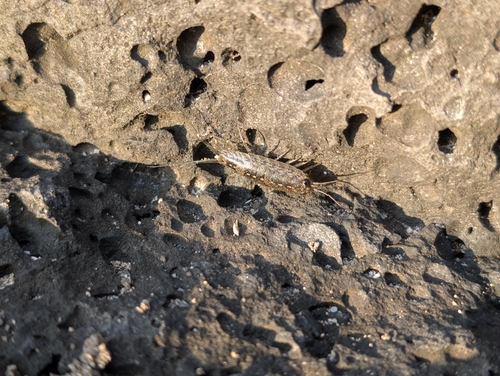
The Wharf Louse is a tiny creature that loves to explore the rocky shores! It can often be found scurrying around in search of food like seaweed and decaying plants.
Habitat: Coastal areas and rocky shorelines
The Wharf Louse has a flattened, oval body, typically grey or brownish-grey, with prominent antennae and many legs. Its segmented shell makes it look like a land-dwelling woodlouse, but it prefers coastal rocks.
Category
InvertebrateRarity
Common
Danger
0/5 · No known danger
Snaps
2
If a wharf louse loses a leg, it can grow a brand new one back! Wow!
They act like tiny cleaners, munching on decaying plants along the coastline.
They are cousins to crabs and lobsters, belonging to the same crustacean family!
Wharf Louse are nocturnal, meaning they are most active exploring under moonlight.
Wharf Louse can breathe both air and water because of special gill-like structures, helping them survive changing tides.
Wharf Louse can dart away quickly when disturbed because of its many legs, helping them avoid predators.
Wharf Louse can regrow lost legs or antennae if they are damaged, helping them recover from injury.
These tiny creatures are important clean-up crew members, eating dead plants and organic bits.

Calidris alba
Shore birds hunt them at low tide.

Fundulus heteroclitus
Small fish snap them up in tide pools.
Ulva lactuca
They scavenge on decaying algae for food.
Describes organisms that break down dead organic material, recycling nutrients back into the ecosystem.
Coastal habitats are dynamic environments located along the interface between land and sea, influenced by tides, waves, and saltwater.
Diurnal animals are primarily active during daylight hours, typically resting or sleeping at night.
Marine habitats encompass all saltwater environments of the Earth's oceans, supporting an immense diversity of aquatic life.

Nocturnal animals are primarily active during the nighttime hours, typically resting or sleeping during the day.
Danger
0/5 · No known danger
No special safety notes yet.
The easiest way to identify Wharf Louse is to use the Snappit nature identifier app.
30 mm
0.5 g
1.5 years
These tiny creatures are important clean-up crew members, eating dead plants and organic bits.
Coastal areas and rocky shorelines
Scavenging
Zoom in to split clusters and explore where this object has been snapped.
Jun 3, 2026
Sea Life Park HawaiiPhoto attribution
(c) Damien Wallace, some rights reserved (CC BY)
License: CC BY 4.0 ↗
Image may be shown cropped inside the card frame.

Alabama, US
You might spot Eastern Lubber Grasshopper, Christmas Lichen, and Anole.
View guide →
Hawaii, US
You might spot Bottlenose Dolphin, Sea Lion, and Sea Turtle.
View guide →

Maryland, US
You might spot Bufflehead, Common Goldeneye, and Duck.
View guide →
Hawaii, US
You might spot Bottlenose Dolphin, Sea Lion, and Sea Turtle.
View guide →
Take the discovery with you
Snap it with Snappit to identify it, learn what makes it special, and add the discovery to your collection.