


Northern Phlox
phlox adsurgens
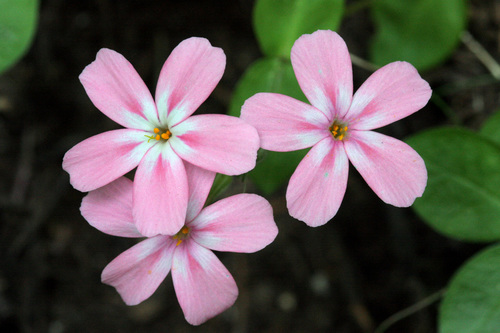
Northern Phlox, scientifically known as Phlox adsurgens, is a charming evergreen perennial wildflower native to the mountains of western North America. This low-growing, mat-forming plant thrives in the filtered light of coniferous and mixed-evergreen forests, particularly within the Klamath region. With its trailing stems and glossy leaves, it creates a lush ground cover that bursts into a spectacular display of pink and white blossoms during the late spring and early summer months.
Habitat: Found in damp, open coniferous forests, woodland margins, and rocky slopes at mid-to-high elevations.
This plant is easily identified by its creeping, trailing stems that can grow up to 30 centimeters in length, covered in glossy, oval-shaped dark green leaves. The striking flowers are five-lobed and measure 1.5 to 2.5 centimeters across. Each petal exhibits a soft pink to rose-salmon hue, beautifully bisected by a distinct, vertical white stripe that gives the bloom a star-like appearance.
Category
PlantsRarity
Common
Danger
1/5 · Very low
Snaps
Be the first to snap!
It has earned the prestigious Award of Garden Merit from the Royal Horticultural Society for its exceptional performance in rock gardens.
The species name 'adsurgens' translates to 'ascending' or 'rising up,' referring to the way its flowering stems elevate themselves from the creeping ground cover.
Unlike many other members of the Phlox genus that demand full sun, this species is highly adapted to deep forest shade.
Utilizes trailing vegetative stolons that root upon contacting the ground, enabling it to rapidly colonize steep, rocky slopes and prevent soil erosion.
Possesses a thick, reflective leaf cuticle that retains moisture, allowing it to withstand dry summer spells beneath dense forest canopies.
Features prominent white central stripes on its pink petals, acting as visual runways that guide pollinators directly to the nectar source.
As a photosynthetic plant, Northern Phlox manufactures its own food using sunlight, carbon dioxide, and water combined with minerals absorbed through its roots.
Bombus vosnesenskii
Visits the flowers for nectar, performing vital pollination services in the process.

Odocoileus hemionus
Browses on the evergreen foliage and tender shoots, particularly during cold winter months.
No trait badges are assigned for this object yet.
No aliases listed yet.
Collections for this object will appear here as more themes are added.
Danger
1/5 · Very low
No special safety notes yet.
Start with the whole plant, then compare leaf arrangement, leaf edges, stems and any flowers or fruit. Opposite leaves grow in pairs; alternate leaves come one at a time along the stem. These details tell you far more together than a single green leaf does. Plant Identifier: upload a photo and compare the visible details.
10-30 cm
3-10 years
As a photosynthetic plant, Northern Phlox manufactures its own food using sunlight, carbon dioxide, and water combined with minerals absorbed through its roots.
Found in damp, open coniferous forests, woodland margins, and rocky slopes at mid-to-high elevations.
Zoom in to split clusters and explore where this object has been snapped.
Recent snaps will appear here as new observations are added.
Take the discovery with you
Snap it with Snappit to identify it, learn what makes it special, and add the discovery to your collection.


















