


Northern Pin Oak
quercus ellipsoidalis
The Northern Pin Oak (Quercus ellipsoidalis) is a medium-sized deciduous tree native to the north-central United States and parts of southern Canada. Well-known for its adaptability to dry, sandy soils, this resilient oak thrives in challenging environments where other hardwoods struggle. It plays a crucial ecological role by providing nesting sites for birds, cover for small mammals, and a vital autumn food source through its abundant acorns. In the landscape, the Northern Pin Oak is highly valued for its striking pyramidal shape in youth, which matures into an ornamental, open canopy. Its deeply lobed leaves turn brilliant shades of red and bronze in the autumn, creating a spectacular display. The persistent dead branches on its lower trunk, a characteristic known as marcescence, give this tree its distinctive "pin-like" appearance and provide winter structure to the forest understory.
Habitat: Typically found in dry, acidic, sandy soils of upland forests, oak savannas, and along glacial outwash plains.
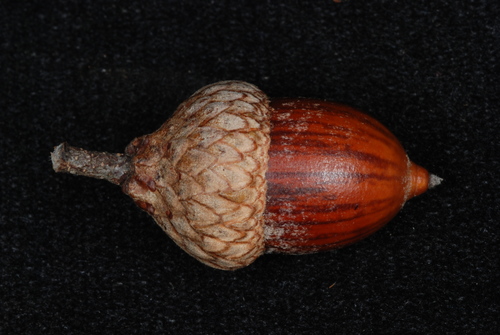
The Northern Pin Oak typically reaches heights of 15 to 22 meters, featuring a straight trunk and a rounded, open crown at maturity. Its leaves are deeply divided by C-shaped sinuses into 5 to 7 lobes, each tipped with sharp bristles, displaying a glossy green top and a paler underside. The bark is greyish-brown, starting smooth and developing shallow, furrowed ridges as the tree ages. The small, ellipsoidal acorns, from which the scientific name is derived, are about 1 to 2 cm long, encased halfway in a saucer-like, hairy cap.
Category
PlantsRarity
Common
Danger
1/5 · Very low
Snaps
Be the first to snap!
Its wood is exceptionally hard and heavy, and historically was used for fuel, fence posts, and railway ties.
The lower branches of the Northern Pin Oak tend to persist for years after dying, creating a protective 'shrubby' layer around the lower trunk.
The species name 'ellipsoidalis' refers to the distinct, egg-shaped or ellipsoidal acorns it produces.
Highly adapted to dry, nutrient-poor, sandy, and acidic soils where other oak species struggle to survive.
Retains dead lower branches and sometimes dry winter foliage, which deters herbivores and helps trap snow to increase moisture around the roots.
Features a deep, extensive taproot system that efficiently searches for deep groundwater during periods of prolonged drought.
As a photosynthetic plant, the Northern Pin Oak generates its own energy from sunlight, water, and atmospheric carbon dioxide, while absorbing essential minerals through its roots.

Cyanocitta cristata
Consumes the acorns and helps disperse the seeds by burying them in the forest floor.

Odocoileus virginianus
Feeds on the highly nutritious acorns and browses the tender young twigs.
Amphibolips confluenta
Lays eggs on leaves and twigs, inducing the tree to form spherical galls that protect larvae.
No trait badges are assigned for this object yet.
No aliases listed yet.
Collections for this object will appear here as more themes are added.
Danger
1/5 · Very low
No special safety notes yet.
Start with the whole plant, then compare leaf arrangement, leaf edges, stems and any flowers or fruit. Opposite leaves grow in pairs; alternate leaves come one at a time along the stem. These details tell you far more together than a single green leaf does. Plant Identifier: upload a photo and compare the visible details.
1500-2200 cm
3000-9000 kg
100-150 years
As a photosynthetic plant, the Northern Pin Oak generates its own energy from sunlight, water, and atmospheric carbon dioxide, while absorbing essential minerals through its roots.
Typically found in dry, acidic, sandy soils of upland forests, oak savannas, and along glacial outwash plains.
Zoom in to split clusters and explore where this object has been snapped.
Recent snaps will appear here as new observations are added.
Take the discovery with you
Snap it with Snappit to identify it, learn what makes it special, and add the discovery to your collection.


















