
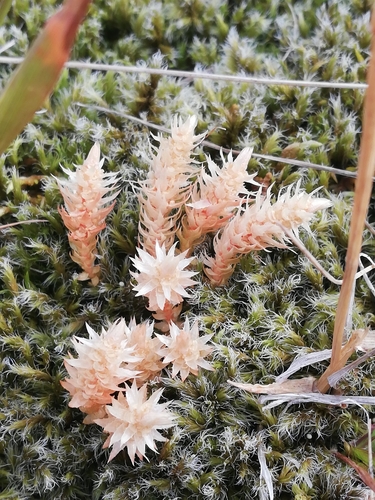


Northern Spikemoss
selaginella selaginoides
Northern Spikemoss (Selaginella selaginoides) is a fascinating, diminutive primitive plant that bridges the gap between mosses and ferns. Belonging to the ancient lineage of lycophytes, this creeping perennial has survived nearly unchanged for millions of years. It thrives in cool, damp, lime-rich environments across the subarctic and alpine zones of the Northern Hemisphere, often carpeting fens, wet ledges, and mossy banks. Unlike true mosses, Northern Spikemoss possesses a vascular system, allowing it to transport water and nutrients efficiently. It plays an important ecological role in stabilizing thin mountain soils and contributing to the biodiversity of delicate wetland ecosystems. Spotting this tiny green survivor offers a glimpse into Earth's deep botanical history.
Habitat: Thrives in wet, calcareous habitats, such as fens, damp rocky ledges, alpine flushes, and mossy tundra.
This low-growing perennial forms loose, creeping mats of sterile, leafy stems that measure just 2 to 10 centimeters in height. Its tiny, scale-like leaves are bright to yellowish-green, lance-shaped, and feature finely toothed margins. During the summer, it develops distinct, erect fertile cones (strobili) at the tips of its branches. These strobili are yellowish, noticeably thicker than the sterile creeping stems, and bear two types of spore-producing structures: small microsporangia near the top and larger, yellowish megasporangia at the base.
Category
PlantsRarity
Common
Danger
1/5 · Very low
Snaps
Be the first to snap!
Despite its name and moss-like look, the Northern Spikemoss is actually an ancient vascular plant more closely related to ferns than to true mosses.
It displays heterospory, generating both small male spores and large female spores, which represents an early evolutionary step toward modern seeds.
Its evolutionary lineage (the Lycophytes) dates back over 400 million years, predating the rise of dinosaurs and flowering plants.
It exhibits heterospory, producing two distinct types of spores (microspores and megaspores) which increases colonization success in alpine habitats.
Can survive brief periods of dryness by slowing its metabolic rate, reviving rapidly when moisture returns.
Possesses special cellular adaptations that prevent damage from freezing, allowing it to survive harsh subarctic winters.
As a photosynthetic plant, it manufactures its own nutrients from sunlight, carbon dioxide, water, and minerals absorbed through its roots.

Rangifer tarandus
Grazed upon occasionally as part of general vegetation intake in alpine tundra environments.
Pinguicula vulgaris
Competes for space and light in wet, calcareous, nutrient-poor seeps and fen edges.
No trait badges are assigned for this object yet.
No aliases listed yet.
Collections for this object will appear here as more themes are added.
Danger
1/5 · Very low
No special safety notes yet.
Start with the whole plant, then compare leaf arrangement, leaf edges, stems and any flowers or fruit. Opposite leaves grow in pairs; alternate leaves come one at a time along the stem. These details tell you far more together than a single green leaf does. Plant Identifier: upload a photo and compare the visible details.
2-10 cm
3-15 years
As a photosynthetic plant, it manufactures its own nutrients from sunlight, carbon dioxide, water, and minerals absorbed through its roots.
Thrives in wet, calcareous habitats, such as fens, damp rocky ledges, alpine flushes, and mossy tundra.
Photosynthesis
Zoom in to split clusters and explore where this object has been snapped.
Recent snaps will appear here as new observations are added.
Take the discovery with you
Snap it with Snappit to identify it, learn what makes it special, and add the discovery to your collection.


















