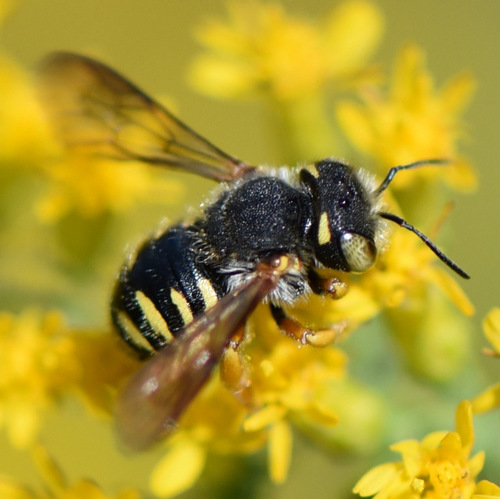


Oblong Woolcarder Bee
anthidium oblongatum
The Oblong Woolcarder Bee (Anthidium oblongatum) is a fascinating solitary bee species belonging to the family Megachilidae. Native to Europe and introduced to North America, this bee is named for its unique nesting behavior. Females collect soft plant hairs from fuzzy leaves to line and seal their nests, which are typically constructed in pre-existing cavities such as rock crevices, hollow stems, or masonry. They are energetic, agile fliers often observed darting quickly between flowers in sunny gardens and meadows. Unlike honeybees, they do not live in colonies; each female works independently to construct her nests and provision her offspring. Males are highly territorial and defensive, patrolling patches of preferred flowers and actively chasing away intruders, including much larger insects. This charismatic bee is a valuable pollinator, particularly drawn to plants in the Fabaceae and Crassulaceae families.
Habitat: Found in warm, sunny habitats such as dry meadows, rocky hillsides, urban gardens, and parks with plentiful gravel, masonry, and nectar-producing plants.
This medium-sized solitary bee is easily recognized by its robust, wasp-like appearance and striking coloration. It typically measures around 1 centimeter in length, with females being slightly smaller than the aggressively territorial males. They have a dark black base color decorated with bold, bright yellow or cream-colored spots along the sides of the abdomen, rather than continuous bands, giving them a segmented, dashed look. Their head and thorax feature dense, pale yellowish hairs, and females possess a specialized pollen-carrying brush on the underside of their abdomen, which is often caked in bright yellow pollen. Their wings are slightly smoky, and their legs are notably stout and yellow-marked.
Category
InsectsRarity
Common
Danger
1/5 · Very low
Snaps
1
These bees often sleep overnight inside flowers or by clamping their jaws onto a plant stem and letting their bodies hang suspended.
They are nicknamed 'woolcarders' because of the female's habit of shaving fuzzy hairs off plants to spin cotton-like nests.
To deter intruders, territorial males are equipped with sharp teeth-like spines on the end of their abdomen, which they use to ram and injure competitors.
Unlike many other bees, males of this species are larger than females, an adaptation that helps them physically dominate and defend territories.
Females use their specialized, toothed mandibles to scrape soft hairs from fuzzy plants to construct cozy, insulated nest cells.
Males establish and aggressively defend rich foraging territories, attacking invading insects with specialized abdominal spines to secure mating rights.
Unlike bumblebees that carry pollen on their hind legs, females carry pollen on a dense brush of hairs located on the underside of their abdomen.
Larvae feed on a rich mixture of pollen and nectar provisioned by the mother, while adults feed exclusively on nectar for energy.

Sedum acre
A major source of nectar and pollen for foraging adults and nest provisioning.

Anthidium manicatum
Competes for nesting sites and foraging resources in similar urban and wild habitats.

Epilobium montanum
Females harvest the soft, woolly seed fibers or leaf hairs from this and related plants to construct nest cells.
No trait badges are assigned for this object yet.
No aliases listed yet.
Collections for this object will appear here as more themes are added.
Danger
1/5 · Very low
No special safety notes yet.
The easiest way to identify Oblong Woolcarder Bee is to use the Snappit nature identifier app.
1+ cm
1+ cm
0.00005+ kg
1+ years
15 km/h
Larvae feed on a rich mixture of pollen and nectar provisioned by the mother, while adults feed exclusively on nectar for energy.
Found in warm, sunny habitats such as dry meadows, rocky hillsides, urban gardens, and parks with plentiful gravel, masonry, and nectar-producing plants.
Zoom in to split clusters and explore where this object has been snapped.
Take the discovery with you
Snap it with Snappit to identify it, learn what makes it special, and add the discovery to your collection.








.jpg)





.jpg&width=800)




