





European Woolcarder Bee
Anthidium manicatum
The European Woolcarder Bee is a fuzzy little bee that loves to collect soft plant fibers. They use these fibers to make cozy nests for their babies. You can often find them buzzing around flowers in gardens and parks!
Habitat: Urban areas
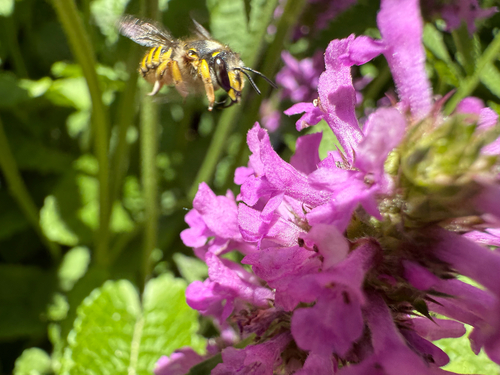
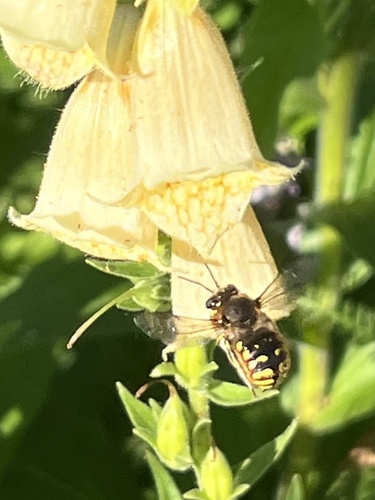
The European Woolcarder Bee has a black body covered in yellow and black fuzz, with bright yellow spots on its abdomen and yellow legs. Males are larger and have five sharp, dark spines at the tip of their abdomen, setting them apart visually from females and other bees.
Category
InsectsRarity
Common
Danger
1/5 · Very low
Snaps
29
Despite being bees, they do not produce any delicious honey for us to eat!
Male bees fight fiercely with spiky 'teeth' on their tail to protect flowers!
Males are much larger and more aggressive than females, often chasing other insects away!
They don't live in a big hive; each female builds her own fluffy, individual nest!
European Woolcarder Bee females scrape soft plant hairs because it helps them construct cozy, waterproof nests for their young.
Male European Woolcarder Bees vigorously defend flower patches that helps them secure mating opportunities and food resources.
Male European Woolcarder Bees have five sharp abdominal spines that helps them fight off rival males and other intruders.
European Woolcarder Bees sip nectar for energy and collect pollen for their developing babies.
Stachys byzantina
collects nectar and plant hairs
Lamium album
visits for nectar and pollen

Passer domesticus
a common insect predator
Leucospis gigas
lays eggs in bee nests
Furry describes animals possessing a dense covering of soft hair or fur.
Social animals live in organized groups, cooperating for survival benefits such as foraging, defense, and raising offspring.
This trait characterizes organisms whose diet consists entirely or primarily of plant material.
Describes plants that are particularly attractive and beneficial to a wide range of pollinating organisms.

Diurnal animals are primarily active during daylight hours, typically resting or sleeping at night.

This habitat trait indicates species that can coexist with humans in urban and suburban environments, utilizing man-made structures and green spaces.

Describes organisms that transfer pollen, enabling the fertilization and reproduction of plants.
No aliases listed yet.
Danger
1/5 · Very low
Woolcarder bees are friendly, but it's best to watch them from a distance.
The easiest way to identify European Woolcarder Bee is to use the Snappit nature identifier app.
20-30 mm
11-17 mm
20-40 days
European Woolcarder Bees sip nectar for energy and collect pollen for their developing babies.
Urban areas
Foraging
6
Zoom in to split clusters and explore where this object has been snapped.
Jun 19, 2026
City ParkPhoto attribution
(c) Jared Lincenberg, some rights reserved (CC BY)
License: CC BY 4.0 ↗
Image may be shown cropped inside the card frame.
May 31, 2026
Oxon Run ParkwayPhoto attribution
(c) Frederick Nunley, some rights reserved (CC BY)
License: CC BY 4.0 ↗
Image may be shown cropped inside the card frame.

Ohio, US
You might spot Eastern Fox Squirrel and Spotted Lanternfly.
View guide →

California, US
You might spot Redwood Sorrel, Redwood, and Button's Banana Slug.
View guide →

California, US
You might spot Monarch, Canada Goose, and Western Gull.
View guide →

Connecticut, US
You might spot Striped Wintergreen and Common Eastern Bumble Bee.
View guide →

New York, US
You might spot White Snakeroot, Rock Pigeon, and Eastern Gray Squirrel.
View guide →

Indiana, US
You might spot Eastern Fox Squirrel, Duck, and Canada Goose.
View guide →
Take the discovery with you
Snap it with Snappit to identify it, learn what makes it special, and add the discovery to your collection.






.jpg&width=800)




