

Opalescent Nudibranch
hermissenda opalescens
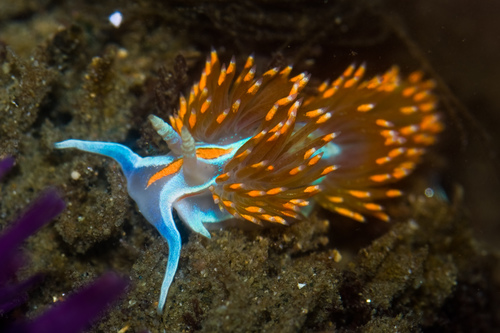
The Opalescent Nudibranch (Hermissenda opalescens) is one of the most breathtaking and aggressively competitive sea slugs found along the Pacific coast of North America. Renowned for its brilliant, glowing coloration, this tiny marine gastropod looks like an underwater firework. Despite its delicate, ethereal appearance, it is a highly active and territorial carnivore, often engaging in fierce battles with other nudibranchs. Its body is covered in soft, finger-like projections called cerata, which not only assist in breathing but also serve as a sophisticated defense system. Tidepoolers and divers alike are continually captivated by its striking presence, making it a favorite find among coastal explorers. Its ability to navigate complex rocky intertidal zones while carrying a stolen arsenal of stinging cells makes it a fascinating marvel of evolutionary adaptation.
Habitat: Typically found in rocky intertidal zones, tidepools, kelp forests, and on boat docks and pilings along the Pacific coast.
This species features a translucent, pearly-white to bluish-grey body highlighted by a brilliant neon orange stripe running down the center of its back, flanked by bright blue or gold lines. Its back is crowded with numerous long, pointed cerata that display vibrant bands of orange, white, and iridescent blue. Two prominent, yellowish-white tentacles extend from its head alongside a pair of ringed rhinophores, which act as sensory organs. It typically reaches lengths of 2 to 8 centimeters, moving with a graceful yet surprisingly rapid crawling motion.
Category
InvertebrateRarity
Common
Danger
1/5 · Very low
Snaps
Be the first to snap!
If they lose their cerata during a fight or predator attack, they can shed them and completely regenerate them within a few weeks.
The brilliant orange and blue lines on its body act as warning coloration, signaling to potential predators that they are highly toxic and armed with stolen stinging cells.
They lay their eggs in highly distinct, white or pinkish-white spiral gelatinous ribbons that look like tiny lace doilies draped over seaweed.
The nudibranch consumes stinging anemones and redirects their unexploded stinging cells to the tips of its own cerata for self-defense.
Unlike many passive slugs, this species actively fights rivals, using its radula to bite and even consume competitors.
Uses highly sensitive, ribbed rhinophores on its head to detect chemical cues in the water, helping it locate prey, mates, or rival nudibranchs.
An aggressive predator that feeds on a wide variety of sessile marine invertebrates, including hydroids, anemones, bryozoans, and other nudibranchs.
Age differences: Juveniles feed primarily on small hydroids, while adults expand their diet to include larger anemones and conspecifics.
Obelia geniculata
Feeds heavily on colonies of this hydroid, absorbing its nematocysts for defense.

Pycnopodia helianthoides
Preyed upon by large sea stars that patrol tidepools and rocky reefs.
Anthopleura elegantissima
Feeds on the tentacles of this anemone, acquiring defensive stinging cells.
No trait badges are assigned for this object yet.
No aliases listed yet.
Collections for this object will appear here as more themes are added.
Danger
1/5 · Very low
No special safety notes yet.
Look for fins, arms, tentacles, shells and body symmetry. Underwater light shifts colors, so structure and markings usually matter more than shade. Sea Creature Identifier: upload a photo and compare the visible details.
2-8 cm
0.002-0.015 kg
1 years
An aggressive predator that feeds on a wide variety of sessile marine invertebrates, including hydroids, anemones, bryozoans, and other nudibranchs.
Typically found in rocky intertidal zones, tidepools, kelp forests, and on boat docks and pilings along the Pacific coast.
Foraging
1000-10000
Zoom in to split clusters and explore where this object has been snapped.
Recent snaps will appear here as new observations are added.

California, US
You might spot Hilton's Aeolid and Opalescent Nudibranch.
View guide →

US
You might spot Ochre Sea Star and Giant Green Anemone.
View guide →

California, US
You might spot Sunburst Anemone and Striped Shore Crab.
View guide →
Take the discovery with you
Snap it with Snappit to identify it, learn what makes it special, and add the discovery to your collection.