

Orange-Fringed Orchid
platanthera ciliaris
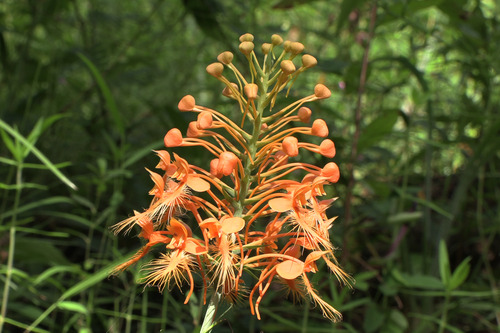
The Orange-Fringed Orchid (Platanthera ciliaris) is a spectacular perennial wildflower native to wet, acidic habitats in eastern North America. Renowned for its brilliant, fiery orange flower spikes, this terrestrial orchid illuminates meadows, bogs, and open pine savannas during the heat of mid-to-late summer. Each robust stem boasts a dense cluster of up to eighty fringed blossoms, creating a visual masterpiece that stands out strikingly against green marsh vegetation. Beyond its striking looks, this orchid plays a vital role in its local ecosystem, acting as a crucial nectar source for large butterflies, particularly swallowtails, which are its primary pollinators.
Habitat: Typically found in acidic, moist environments such as sphagnum bogs, wet pine barrens, damp meadows, and savannas.
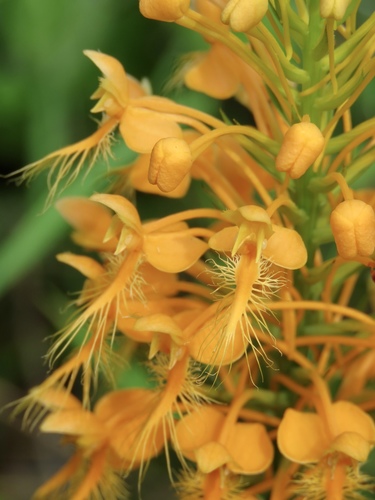
This terrestrial orchid stands 30 to 90 centimeters tall, featuring an erect, unbranched stem clad in lance-shaped, alternating green leaves. Its crowning glory is a dense, cylindrical cluster of 30 to 80 bright orange to deep yellow-orange flowers. Each individual bloom is highly detailed, featuring a deeply fringed, tongue-like lip that extends into a long, nectar-filled spur of up to 2.5 centimeters, designed specifically for long-tongued insect pollinators.
Category
PlantsRarity
Common
Danger
1/5 · Very low
Snaps
Be the first to snap!
Each flower possesses a nectar spur that can be up to 2.5 centimeters long, perfectly matching the proboscis length of swallowtail butterflies.
The common name 'fringed' refers to the highly dissected, lace-like appearance of the lower flower petal.
The seeds of the Orange-Fringed Orchid are dust-like and contain no nutrient reserves; they cannot germinate without a fungal partner.
Relies on a symbiotic relationship with subterranean fungi to supply essential nutrients during seed germination and early development.
Features a long, nectar-filled floral spur that limits access to specific, highly effective long-tongued pollinators like swallowtail butterflies.
Thrives in fire-prone pine savannas, where periodic burns clear competing woody vegetation and stimulate robust seasonal orchid growth.
Like most plants, this orchid produces its own food via photosynthesis, supplemented by nutrients absorbed from the soil through symbiotic mycorrhizal fungi.
Age differences: Seedlings are fully dependent on mycorrhizal fungi for nutrients before developing photosynthetic leaves.

Papilio troilus
The Spicebush Swallowtail pollinates the orchid while feeding on its deep nectar deposits.
Ceratobasidium species
Essential mycorrhizal fungus that colonizes orchid seeds to assist in germination and nutrient absorption.

Battus philenor
This swallowtail uses its long proboscis to access nectar, facilitating cross-pollination.
No trait badges are assigned for this object yet.
No aliases listed yet.
Collections for this object will appear here as more themes are added.
Danger
1/5 · Very low
No special safety notes yet.
Start with the whole plant, then compare leaf arrangement, leaf edges, stems and any flowers or fruit. Opposite leaves grow in pairs; alternate leaves come one at a time along the stem. These details tell you far more together than a single green leaf does. Plant Identifier: upload a photo and compare the visible details.
30-90 cm
0.05-0.2 kg
5-20 years
Like most plants, this orchid produces its own food via photosynthesis, supplemented by nutrients absorbed from the soil through symbiotic mycorrhizal fungi.
Typically found in acidic, moist environments such as sphagnum bogs, wet pine barrens, damp meadows, and savannas.
Zoom in to split clusters and explore where this object has been snapped.
Recent snaps will appear here as new observations are added.
Take the discovery with you
Snap it with Snappit to identify it, learn what makes it special, and add the discovery to your collection.