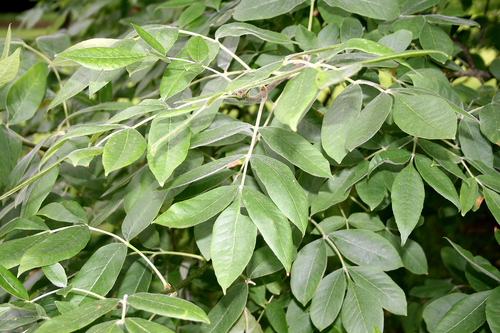


Oregon Ash
fraxinus latifolia
The Oregon Ash (Fraxinus latifolia) is a prominent deciduous tree native to the riparian zones of western North America. This species plays a crucial ecological role in its habitat, providing essential shade, bank stabilization, and wildlife habitat along streams and rivers. Known for its robust growth and adaptability to wet conditions, it is a key component of floodplain forests and contributes significantly to the biodiversity of these sensitive ecosystems. Its presence often indicates a healthy wetland environment, making it a valuable indicator species for riparian health. Historically, its strong, elastic wood has been utilized by indigenous peoples and early settlers for various purposes.
Habitat: Found primarily in wet, riparian habitats such as floodplains, stream banks, river bottoms, and moist forest edges.
Oregon Ash trees typically grow to heights of 15 to 25 meters, featuring a relatively open, rounded crown. The bark is gray-brown, becoming furrowed with age. Its leaves are oppositely arranged and pinnately compound, consisting of 5 to 9 (usually 7) ovate to elliptical leaflets, each 6-12 cm long, with finely serrated margins and a smooth to slightly hairy underside. Inconspicuous greenish flowers appear in clusters before the leaves emerge in spring, followed by distinctive winged fruits called samaras. These samaras are paddle-shaped, 3-5 cm long, and mature to a light brown in late summer or fall, facilitating wind dispersal.
Category
PlantsRarity
Common
Danger
1/5 · Very low
Snaps
1
It is the only ash species native to the low-elevation regions of the Pacific Northwest west of the Cascade Range.
Its presence is often a good indicator of consistently moist soil conditions, making it a valuable species for identifying wetland areas.
Oregon Ash plays a vital role in maintaining the health of riparian ecosystems by stabilizing soil, preventing erosion, and filtering water.
The wood of Oregon Ash is known for its strength, flexibility, and shock resistance, making it suitable for tool handles and sporting goods.
Oregon Ash is well-adapted to saturated soils and periodic flooding, thriving in conditions that many other tree species cannot tolerate. Its root system can withstand prolonged waterlogging.
This species exhibits a relatively fast growth rate, allowing it to quickly establish and colonize disturbed riparian areas. This helps in ecosystem recovery and bank stabilization.
The distinctive winged samara fruits are efficiently carried by wind and water, enabling effective seed dispersal over broad areas, particularly along flowing waterways, ensuring reproduction and spread.
As a tree, the Oregon Ash is an autotroph, producing its own food through photosynthesis using sunlight, water, and carbon dioxide. It also absorbs essential nutrients from the soil.
Sphinx chersis
Host plant for larvae of various moths.
Odocoileus hemionus columbianus
Leaves and twigs are a food source for browsing herbivores.
.jpg&width=800)
Piranga ludoviciana
Provides nesting sites and perches for birds.
Prociphilus fraxinifolii
A common pest that causes distortion and curling of ash leaves.
No trait badges are assigned for this object yet.
No aliases listed yet.
Collections for this object will appear here as more themes are added.
Danger
1/5 · Very low
No special safety notes yet.
The easiest way to identify Oregon Ash is to use the Snappit nature identifier app.
1500-2500 cm
500-2000 kg
80-150 years
As a tree, the Oregon Ash is an autotroph, producing its own food through photosynthesis using sunlight, water, and carbon dioxide. It also absorbs essential nutrients from the soil.
Found primarily in wet, riparian habitats such as floodplains, stream banks, river bottoms, and moist forest edges.
Foraging
Zoom in to split clusters and explore where this object has been snapped.
Take the discovery with you
Snap it with Snappit to identify it, learn what makes it special, and add the discovery to your collection.













.jpg&width=800)



_001.jpg&width=800)




