.jpg&width=800)





Western Tanager
Piranga ludoviciana
The Western Tanager is a colorful bird with bright yellow feathers and a red head. They love to sing and can be found in forests, especially during the summer when they come to find food.
Habitat: Forests
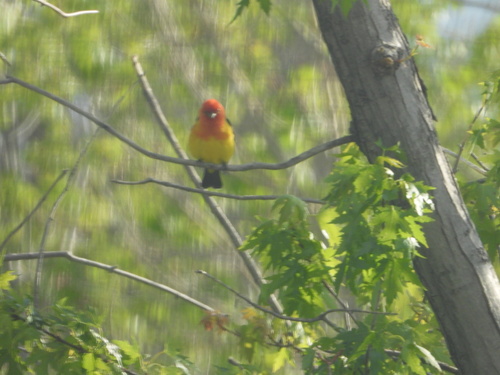
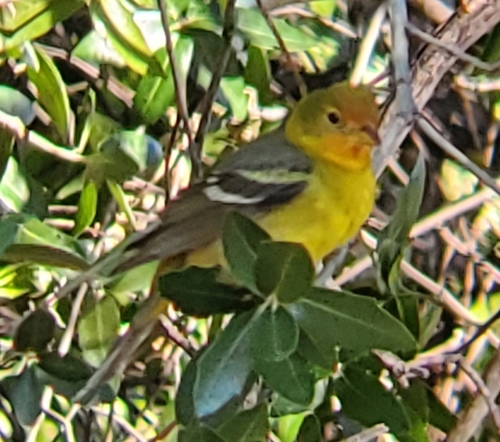
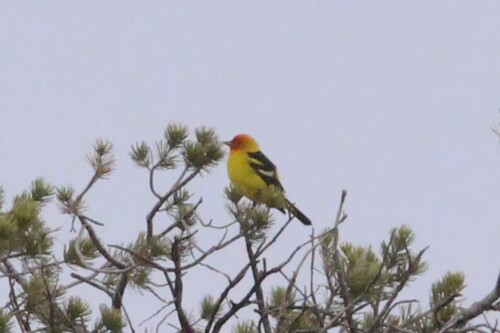
The Western Tanager male has a striking fiery-red head, brilliant yellow body, and contrasting black wings with two white wing bars. Females are duller yellow-green with dusky wings and no red. This vivid coloration makes it easily distinct from other tanager species.
Category
BirdsRarity
Common
Danger
1/5 · Very low
Snaps
36
Males often look like they dipped their head in a pot of red paint!
Their cheerful, robin-like song can often be heard from the treetops.
They build cup-shaped nests hidden high in coniferous trees for safety!
Young tanagers are often fed juicy caterpillars by their parents!
Western Tanager can navigate thousands of kilometers during migration because they use celestial cues and Earth's magnetic field.
Western Tanager can catch flying insects mid-air because of their quick reflexes and agile flight.
Western Tanager males get their vibrant red head feathers through a complex metabolic process, not just diet like some birds.
These colorful birds enjoy a delicious mix of insects, spiders, and juicy berries!
Age differences: Adults switch from a largely insect diet in summer to more fruits in fall/winter.
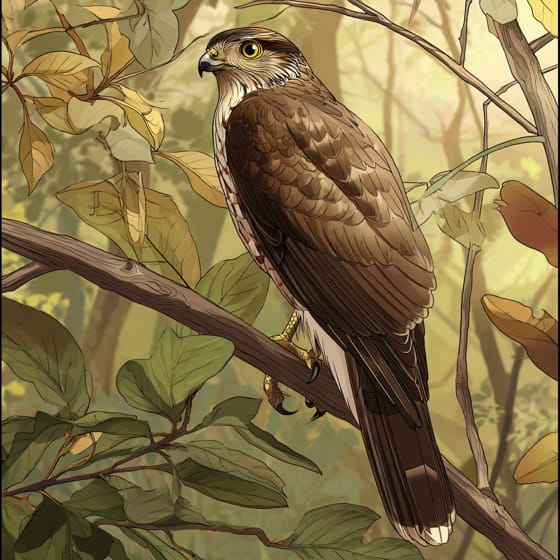
Accipiter cooperii
A swift predator that preys on smaller birds.
.jpg&width=800)
Molothrus ater
Lays its eggs in the nests of Western Tanagers.
.jpg&width=800)
Rubus idaeus
Consumes the sweet berries, especially during migration.
Apis mellifera
Forages on insects, including flying bees and wasps.
Feathered describes animals, primarily birds, possessing a covering of feathers.
Social animals live in organized groups, cooperating for survival benefits such as foraging, defense, and raising offspring.
Singing animals produce complex vocalizations, often for purposes of attracting mates, defending territory, or communicating within their species.
Colorful describes organisms or objects displaying a wide range of bright and distinct colors.

This trait identifies organisms whose diet primarily consists of insects and other small invertebrates.

Forest habitats are terrestrial environments dominated by dense tree cover, supporting a high diversity of plant and animal life.

Migratory animals undertake seasonal movements from one region to another, typically in response to changes in climate or food availability.
Danger
1/5 · Very low
Enjoy watching birds from a distance and never try to touch or catch them.
The easiest way to identify Western Tanager is to use the Snappit nature identifier app.
16-19 cm
28-32 cm
0.024-0.038 kg
5-10 years
45 km/h
These colorful birds enjoy a delicious mix of insects, spiders, and juicy berries!
Forests
Zoom in to split clusters and explore where this object has been snapped.
May 20, 2026
Cheyenne Botanic GardensPhoto attribution
(c) Austin Saunders, some rights reserved (CC BY)
License: CC BY 4.0 ↗
Image may be shown cropped inside the card frame.
May 10, 2026
Madera CanyonPhoto attribution
no rights reserved
License: CC0 1.0 ↗
Image may be shown cropped inside the card frame.
May 4, 2026
Gallup Commercial Historic DistrictPhoto attribution
(c) William Harmon, some rights reserved (CC BY)
License: CC BY 4.0 ↗
Image may be shown cropped inside the card frame.

California, US
You might spot Sequoia, California Newt, and Pacific Dogwood.
View guide →

Utah, US
You might spot Common Golden-Mantled Ground Squirrel and Steller's Jay.
View guide →

Utah, US
You might spot Common Golden-Mantled Ground Squirrel and Steller's Jay.
View guide →

Michigan, US
You might spot Yellow Lady's Slipper and Ring-Billed Gull.
View guide →

Colorado, US
You might spot Common Starlily and Wholeleaf Paintbrush.
View guide →

California, US
You might spot Great Blue Heron, Western Gull, and Coyote.
View guide →
Take the discovery with you
Snap it with Snappit to identify it, learn what makes it special, and add the discovery to your collection.




.jpg&width=800)







