

Ovate Catchfly
silene ovata
The Ovate Catchfly (Silene ovata) is a rare and captivating perennial wildflower native to the rich, shaded forests of the southeastern United States. Standing tall with its sprawling stems, this plant is a member of the pink family (Caryophyllaceae) and is renowned for its delicate, deeply fringed white flowers that unfurl primarily at night. It plays a vital role in its native woodland ecosystem, offering nectar to nocturnal pollinators while clinging to steep, rocky slopes and moist forest floors. Historically restricted in range and sensitive to habitat disruption, the Ovate Catchfly is a treasure for native plant enthusiasts. Its unique defense mechanisms, including sticky glands that trap crawling insects, make it an evolutionary marvel. Spotting this elusive beauty in the wild provides a rewarding glimpse into the rich, undisturbed forest habitats it calls home.
Habitat: Found in rich, moist deciduous forests, steep wooded slopes, and calcareous rocky bluffs in the southeastern United States.
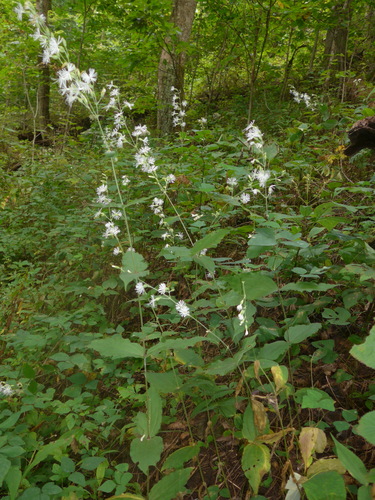
This herbaceous plant grows between 30 and 150 cm tall, featuring erect to sprawling stems covered in soft, velvety hairs and sticky glands. Its leaves are oppositely arranged, broadly ovate, and sessile, measuring up to 12 cm long. The most striking feature is the clusters of nocturnal white flowers at the branch tips, each boasting five petals that are deeply divided into multiple narrow, fringe-like lobes, giving them a feathery, starburst appearance.
Category
PlantsRarity
Common
Danger
1/5 · Very low
Snaps
Be the first to snap!
Because it blooms from late summer into early autumn, it is one of the last forest understory wildflowers to flower in its native range.
Despite its common name 'catchfly' and its sticky stem hairs, this plant is not carnivorous and does not digest the insects it traps.
The deeply fringed, feathery petals are specifically designed to provide a delicate landing platform for hovering nocturnal moths.
The stems and calyces are coated with sticky, glandular hairs that trap crawling herbivorous insects, preventing them from reaching and damaging the delicate blooms.
Its white, fringed petals expand fully at night and emit a subtle scent to attract night-active pollinators like moths.
Its deep, perennial root system allows it to anchor firmly on steep, unstable rocky slopes and forest banks where other plants struggle to secure a foothold.
As a photosynthetic plant, the Ovate Catchfly generates its own food using sunlight, carbon dioxide, water, and essential soil nutrients.
Ceratomia undulosa
Pollinated by night-flying moths, which are attracted to its pale, fringed petals and evening scent.

Odocoileus virginianus
Foliage and stems may be grazed by native herbivores, although sticky stems deter smaller pests.
Sibinia gravida
Subject to seed predation or plant damage by various native weevils.
No trait badges are assigned for this object yet.
No aliases listed yet.
Collections for this object will appear here as more themes are added.
Danger
1/5 · Very low
No special safety notes yet.
Start with the whole plant, then compare leaf arrangement, leaf edges, stems and any flowers or fruit. Opposite leaves grow in pairs; alternate leaves come one at a time along the stem. These details tell you far more together than a single green leaf does. Plant Identifier: upload a photo and compare the visible details.
30+ cm
0.05+ kg
3+ years
As a photosynthetic plant, the Ovate Catchfly generates its own food using sunlight, carbon dioxide, water, and essential soil nutrients.
Found in rich, moist deciduous forests, steep wooded slopes, and calcareous rocky bluffs in the southeastern United States.
Zoom in to split clusters and explore where this object has been snapped.
Recent snaps will appear here as new observations are added.
Take the discovery with you
Snap it with Snappit to identify it, learn what makes it special, and add the discovery to your collection.