


Pa'Iniu
astelia argyrocoma
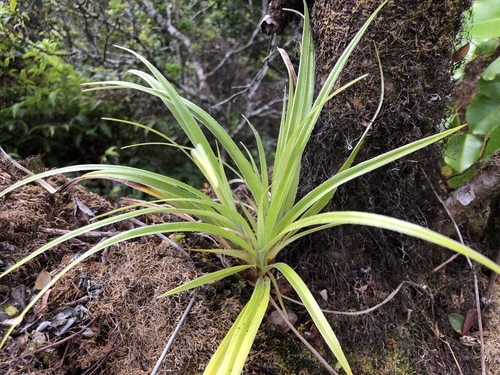
Pa'Iniu (Astelia argyrocoma) is a striking, silver-sheened perennial herb endemic to the wet, high-elevation forests and bogs of Kauai, Hawaii. Growing both on the forest floor and high up in the mossy canopy as an epiphyte, this plant is an iconic component of the Alakai Wilderness Preserve. Its long, sword-like leaves are renowned for their brilliant, reflective coating of microscopic silvery scales, which help it thrive in the misty, high-UV mountain environment. Historically, Native Hawaiians highly valued the shimmering leaves of the pa'iniu, carefully weaving them into beautiful lei and utilizing them for traditional ornamentation. Today, it remains a vital ecological anchor in its native ecosystem, providing structure, moisture retention, and food for a variety of unique Hawaiian forest birds and insects.
Habitat: Found in high-elevation montane wet forests and bogs, often growing epiphytically on mossy branches of trees.
This plant is easily recognized by its dense, rosette-forming clump of long, sword-shaped leaves that grow up to 120 cm in length. The upper surfaces of the leaves are a soft green, but the undersides and margins are heavily coated in dense, appressed scales that shimmer with a brilliant, metallic silver or gold hue. When in bloom, it produces small, inconspicuous clusters of greenish-white flowers on a central stalk, which later mature into fleshy orange or yellow berries that stand out brightly against the metallic foliage.
Category
PlantsRarity
Common
Danger
1/5 · Very low
Snaps
Be the first to snap!
Despite its grass-like or bromeliad-like appearance, the pa'iniu actually belongs to the family Asteliaceae, which is closely related to asparagus.
Its scientific species name, argyrocoma, literally translates to 'silver-haired', referring to the dense, shimmering scales on its leaves.
The reflective silvery scales on the leaves were traditionally stripped by Native Hawaiians and woven into lei to create a striking, sparkling effect.
The dense layer of microscopic scales on its leaves acts as a highly reflective shield, protecting the plant from intense high-elevation solar radiation.
It can grow without soil, anchoring itself to mossy tree branches and absorbing moisture and nutrients directly from the humid air and organic debris.
The rosette arrangement of its V-shaped leaves is perfectly designed to channel rainfall and heavy mist directly down to the plant's base, ensuring constant hydration.
As a photosynthetic plant, it utilizes chlorophyll and sunlight to convert carbon dioxide and water into vital sugars and energy.
Metrosideros polymorpha
Grows epiphytically on the trunk and branches of this native Hawaiian tree, utilizing it as physical support.
Myadestes palmeri
The fleshy orange berries of the pa'iniu serve as an important food source for this critically endangered native thrush.
Hedychium gardnerianum
Competes for space and nutrients on the forest floor and tree trunks with this aggressive, invasive ginger plant.
No trait badges are assigned for this object yet.
No aliases listed yet.
Collections for this object will appear here as more themes are added.
Danger
1/5 · Very low
No special safety notes yet.
Start with the whole plant, then compare leaf arrangement, leaf edges, stems and any flowers or fruit. Opposite leaves grow in pairs; alternate leaves come one at a time along the stem. These details tell you far more together than a single green leaf does. Plant Identifier: upload a photo and compare the visible details.
30-120 cm
0.5-4 kg
10-40 years
As a photosynthetic plant, it utilizes chlorophyll and sunlight to convert carbon dioxide and water into vital sugars and energy.
Found in high-elevation montane wet forests and bogs, often growing epiphytically on mossy branches of trees.
Zoom in to split clusters and explore where this object has been snapped.
Recent snaps will appear here as new observations are added.
Take the discovery with you
Snap it with Snappit to identify it, learn what makes it special, and add the discovery to your collection.


















