


Palmer'S Penstemon
penstemon palmeri
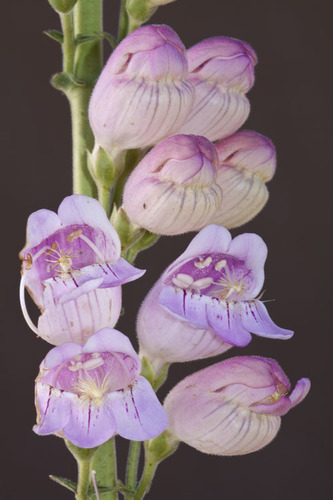
Palmer's Penstemon (Penstemon palmeri) is one of the most magnificent and aromatic wildflowers of the American Southwest. Known for its towering stalks of showy, balloon-like blossoms, this striking perennial stands out dramatically against the arid landscapes it calls home. Unlike many other beardtongues, this species is intensely fragrant, emitting a sweet, honey-like perfume that carries on the desert breeze to attract a wide variety of native pollinators. It thrives in rocky, well-draining soils, displaying remarkable resilience to drought and extreme heat. Its sturdy, upright growth and pale pink-to-lavender flowers make it a favorite for native plant gardens and xeriscaping, while in the wild, it serves as a critical food source for bees, butterflies, and hummingbirds during the late spring and summer months.
Habitat: Found in arid, rocky washes, desert scrublands, pinyon-juniper woodlands, and roadside banks of the southwestern United States.
This plant features robust, erect stems reaching heights of 60 to 180 cm, lined with distinctive blue-green, lance-shaped leaves that fuse together around the stem to form a cup. The showy flowers are large, swollen, and bell-shaped, typically pale pink to lavender-pink, with white throats marked by prominent reddish-purple nectar guides. The lower lip of the bloom is famously bearded with fine yellow hairs, giving it the common name "beardtongue."
Category
PlantsRarity
Common
Danger
1/5 · Very low
Snaps
Be the first to snap!
It is one of the few species of Penstemon that possesses a highly noticeable, sweet fragrance, which is often described as smelling like honey or cloves.
Its large, inflated flowers are perfectly shaped for bumblebees, which must physically squeeze inside the bloom to reach the nectar, getting covered in pollen in the process.
The fused leaves of Palmer's Penstemon surround the stem completely, creating a unique cup-like structure that can hold small amounts of water.
Unlike most penstemons, it releases a strong, sweet scent to attract specific nocturnal and diurnal pollinators across long desert distances.
The fused leaf bases form a cup around the stem that can collect dew and rainwater, helping the plant survive dry periods.
Develops a deep, woody taproot system that anchors the plant in gravelly soils and accesses deep moisture reserves.
As a photosynthetic plant, it synthesizes its own food using sunlight, water, and carbon dioxide, while absorbing essential minerals through its root system.
Bombus nevadensis
Provides essential nectar and serves as a major pollination partner.
Euphydryas chalcedona
Acts as a host plant for the caterpillars of this butterfly species.

Calypte anna
Attracted by the tubular pink flowers to feed on rich nectar stores.
No trait badges are assigned for this object yet.
No aliases listed yet.
Collections for this object will appear here as more themes are added.
Danger
1/5 · Very low
No special safety notes yet.
Start with the whole plant, then compare leaf arrangement, leaf edges, stems and any flowers or fruit. Opposite leaves grow in pairs; alternate leaves come one at a time along the stem. These details tell you far more together than a single green leaf does. Plant Identifier: upload a photo and compare the visible details.
60-180 cm
2-5 years
As a photosynthetic plant, it synthesizes its own food using sunlight, water, and carbon dioxide, while absorbing essential minerals through its root system.
Found in arid, rocky washes, desert scrublands, pinyon-juniper woodlands, and roadside banks of the southwestern United States.
Zoom in to split clusters and explore where this object has been snapped.
Recent snaps will appear here as new observations are added.
Take the discovery with you
Snap it with Snappit to identify it, learn what makes it special, and add the discovery to your collection.


















