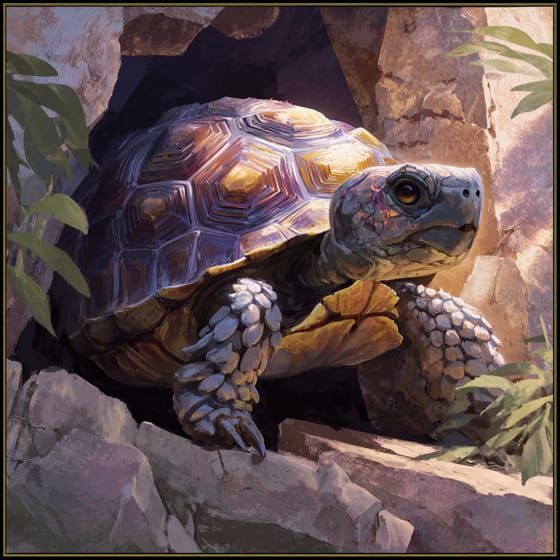





Pancake Tortoise
Malacochersus tornieri
The Pancake Tortoise has a flat, pancake-like shell! They are unique and love to hide in rocks and crevices.
Habitat: Rocky areas
The Pancake Tortoise has an unusually flat, oval-shaped shell, typically light brown to tan with irregular dark markings. Its flexible carapace, distinct from the dome-shaped shells of other tortoises, allows it to squeeze into narrow rock crevices. It often has yellow or cream markings on its plastron.
Category
ReptilesRarity
Epic
Danger
2/5 · Low
Snaps
Be the first to snap!
Its unique shell is so flexible, it can actually feel soft to the touch, unlike most tortoises!
Pancake Tortoises are among the fastest-moving tortoise species, despite their small size.
These tortoises often live in small communities, sharing rock shelters with several other Pancake Tortoises.
When threatened, it can inflate its body with air, wedging itself even tighter into rock crevices.
Pancake Tortoises can squeeze into impossibly tight rock cracks because their flat, flexible shell compresses, making them impossible to extract.
Pancake Tortoises are surprisingly quick and agile, scrambling over rocks and through crevices that helps them escape predators swiftly.
Pancake Tortoises can climb steep, rocky surfaces using strong claws and their unique shell shape that helps them grip and wedge for stability.
Eats mostly leafy plants, grasses, and dried vegetation from its arid home.
Aquila rapax
Eagles are a key predator of young tortoises in their habitat.
Canis mesomelas
Jackals can predate on adult and young tortoises.
Themeda triandra
A common grass in their East African savanna habitat.
Aloe secunda
Succulent leaves provide moisture in arid environments.
Wildlife encompasses all undomesticated animal and plant life existing in their natural habitats.
Social animals live in organized groups, cooperating for survival benefits such as foraging, defense, and raising offspring.
This trait characterizes organisms whose diet consists entirely or primarily of plant material.
This trait characterizes organisms with an exceptionally long lifespan compared to others of their kind.

Armored describes animals protected by a hard, external covering or shell for defense.

Nocturnal animals are primarily active during the nighttime hours, typically resting or sleeping during the day.
Danger
2/5 · Low
Look but don’t touch. Keep a safe distance and wash hands after exploring.
The easiest way to identify Pancake Tortoise is to use the Snappit nature identifier app.
15-18 cm
0.2-0.5 kg
20-35 years
0.3 km/h
Eats mostly leafy plants, grasses, and dried vegetation from its arid home.
Rocky areas
Foraging
Zoom in to split clusters and explore where this object has been snapped.
Recent snaps will appear here as new observations are added.
Take the discovery with you
Snap it with Snappit to identify it, learn what makes it special, and add the discovery to your collection.

















