





Passiflora 'Scarlet Flame'
passiflora miniata × vitifolia
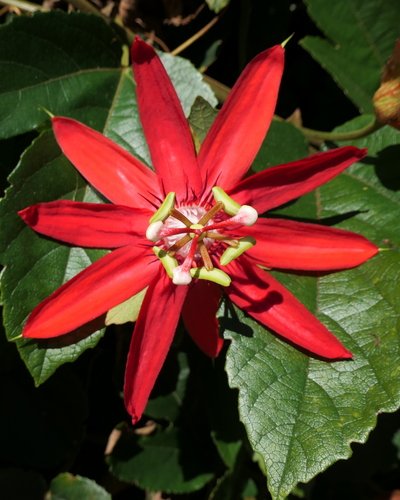
The Passiflora 'Scarlet Flame' is a beautiful climbing plant with bright red flowers that attract butterflies. It's a fun plant to watch as it grows and twines around supports in your garden!
Habitat: Tropical and subtropical regions, often found in gardens and greenhouses.
The Passiflora 'Scarlet Flame' has striking, vivid scarlet-red flowers with an intricate central corona of white and purple filaments. Its large, deeply lobed green leaves provide a lush backdrop to the dramatic blooms, making it visually distinct from many other passionflowers.
Category
PlantsRarity
Common
Danger
1/5 · Very low
Snaps
Be the first to snap!
Butterflies love to visit these bright flowers, helping them make seeds!
Its super intricate flowers were once thought to represent religious symbols!
Some passionflower vines can produce yummy, sweet fruit that people enjoy!
The amazing blooms often last only one day, making each sighting extra special!
Passiflora 'Scarlet Flame' has specialized tendrils that coil around supports, helping it climb high for sunlight.
Passiflora 'Scarlet Flame' displays bright red petals and intricate patterns to guide pollinators directly to its nectar.
Passiflora 'Scarlet Flame' can produce sweet nectar on its leaves to attract ants, which defend it from pests.
Bombus impatiens
Collects pollen and nectar from the flowers.

Heliconius charithonia
Its caterpillars feed on passionflower leaves.

Archilochus colubris
Sips nectar from the bright red blooms.
Social animals live in organized groups, cooperating for survival benefits such as foraging, defense, and raising offspring.
Arboreal animals live primarily in trees, utilizing them for shelter, food, and protection from predators.
Colorful describes organisms or objects displaying a wide range of bright and distinct colors.
This trait characterizes organisms whose diet consists entirely or primarily of plant material.

Describes organisms that transfer pollen, enabling the fertilization and reproduction of plants.
Danger
1/5 · Very low
No special safety notes yet.
The easiest way to identify Passiflora 'Scarlet Flame' is to use the Snappit nature identifier app.
300-600 cm
100-300 cm
8-12 cm
Late Spring to Early Fall
No
Mild
Perennial
Zoom in to split clusters and explore where this object has been snapped.
Recent snaps will appear here as new observations are added.
Take the discovery with you
Snap it with Snappit to identify it, learn what makes it special, and add the discovery to your collection.









.jpg&width=800)



_001.jpg&width=800)




