


Pilo
coprosma montana
Pilo, scientifically known as Coprosma montana, is a resilient and integral native shrub found in the alpine and subalpine regions of New Zealand. This hardy plant plays a crucial ecological role in its harsh environment, often forming dense thickets that provide shelter and stability to delicate mountain ecosystems. Its adaptability to extreme conditions, from high winds to intense UV radiation and cold temperatures, makes it a fascinating example of evolutionary success in challenging habitats. Pilo contributes significantly to biodiversity by offering food resources to native birds and invertebrates, highlighting its importance in the intricate web of mountain life.
Habitat: Found predominantly in subalpine and alpine scrublands, rocky outcrops, and montane forests, often in exposed, high-altitude environments.
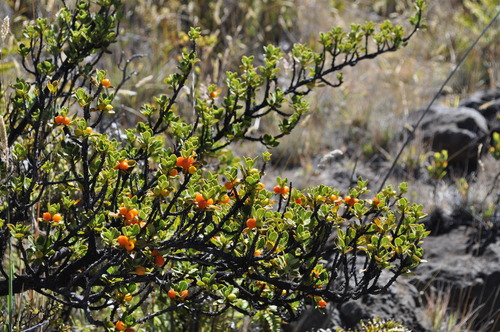
Pilo typically presents as a small to medium-sized shrub, often forming dense, tangled masses. Its leaves are small, thick, and leathery, an adaptation to reduce water loss and withstand harsh conditions. They are generally dark green, often with a glossy surface, and can appear somewhat bronzed in exposed areas. The plant is dioecious, bearing inconspicuous green flowers that mature into small, fleshy, red or orange drupes (berries) that are visually striking against the foliage when ripe. The branches are stiff and often intertwine, contributing to its compact and robust appearance.
Category
PlantsRarity
Common
Danger
1/5 · Very low
Snaps
Be the first to snap!
Like many New Zealand native plants, Coprosma montana has small, green, inconspicuous flowers that are wind-pollinated or pollinated by small, native insects.
Pilo's name 'Coprosma' comes from the Greek 'kopros' (dung) and 'osme' (smell), referring to the unpleasant scent of the crushed leaves of some species in the genus.
The small, tough leaves of Coprosma montana are specially adapted to withstand extreme desiccation and freezing temperatures common in its high-altitude habitat.
Coprosma montana possesses robust adaptations, including small, leathery leaves and a compact growth form, enabling it to thrive in the harsh, exposed conditions of alpine environments with strong winds, cold temperatures, and intense UV radiation.
With separate male and female plants, Pilo promotes outcrossing, enhancing genetic diversity and resilience within its populations, which is vital for adapting to changing environmental pressures.
The plant produces small, vibrant red or orange fleshy fruits (drupes) that are highly attractive to native birds, facilitating efficient seed dispersal across its mountainous habitat.
As an autotrophic plant, Pilo generates its own energy through photosynthesis, utilizing sunlight, carbon dioxide from the atmosphere, and water, along with essential mineral nutrients absorbed from the soil.
Prosthemadera novaeseelandiae
Feeds on the plant's fruits, aiding in seed dispersal.

Cervus elaphus
Browses on the leaves and stems of the shrub.

Various species
Associated with the plant's root system, enhancing nutrient uptake.
Various species
Pollinates the flowers, facilitating reproduction.
No trait badges are assigned for this object yet.
No aliases listed yet.
Collections for this object will appear here as more themes are added.
Danger
1/5 · Very low
No special safety notes yet.
Start with the whole plant, then compare leaf arrangement, leaf edges, stems and any flowers or fruit. Opposite leaves grow in pairs; alternate leaves come one at a time along the stem. These details tell you far more together than a single green leaf does. Plant Identifier: upload a photo and compare the visible details.
50-250 cm
2-20 kg
20-80 years
As an autotrophic plant, Pilo generates its own energy through photosynthesis, utilizing sunlight, carbon dioxide from the atmosphere, and water, along with essential mineral nutrients absorbed from the soil.
Found predominantly in subalpine and alpine scrublands, rocky outcrops, and montane forests, often in exposed, high-altitude environments.
Foraging
Zoom in to split clusters and explore where this object has been snapped.
Recent snaps will appear here as new observations are added.
Take the discovery with you
Snap it with Snappit to identify it, learn what makes it special, and add the discovery to your collection.

















