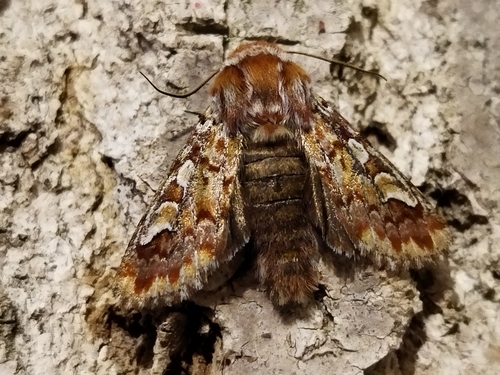


Pine Beauty
panolis flammea
The Pine Beauty (Panolis flammea) is a striking moth species belonging to the Noctuidae family, renowned for its close association with pine trees. This insect plays a dual role in its ecosystem; while its caterpillars are a vital part of the food chain, they can also become significant forestry pests during outbreak years, causing extensive defoliation in pine plantations. Adult moths are typically seen in early spring, heralding the warmer months, and their unique coloration helps them blend seamlessly with their coniferous environment. Understanding the Pine Beauty's life cycle and ecological interactions is crucial for forest management and biodiversity conservation.
Habitat: Found primarily in dense coniferous forests, particularly those dominated by Scots Pine (Pinus sylvestris) and Lodgepole Pine (Pinus contorta), as well as pine plantations.
Adult Pine Beauty moths typically have a wingspan ranging from 3.2 to 4.2 cm. Their forewings are a distinctive reddish-brown or orange-brown, often with a velvety texture. Each forewing features prominent kidney-shaped (reniform) and oval (orbicular) spots, which are usually outlined in white or pale yellow. A pale, wavy subterminal line and a darker streak at the base of the wing are also characteristic. The hindwings are generally greyish-brown, sometimes displaying a faint darker band. The slender body of the moth matches the coloration of its forewings.
Category
InsectsRarity
Common
Danger
1/5 · Very low
Snaps
Be the first to snap!
Adult Pine Beauties are strongly nocturnal and, like many moths, are often attracted to artificial lights, making them easier to spot near human settlements within their range.
Despite their potential as pests, Pine Beauty larvae are a crucial food source for various forest birds and insect parasitoids, contributing to the forest ecosystem's balance.
Pine Beauty moth outbreaks can be a serious concern for commercial forestry, sometimes leading to widespread tree defoliation and growth reduction.
The moth's scientific name, 'Panolis flammea', hints at its fiery, flame-like coloration, especially noticeable on its reddish-orange forewings.
The larvae are cryptically colored green with longitudinal white stripes, allowing them to blend almost perfectly with pine needles, providing excellent camouflage from predators.
This species overwinters reliably as a pupa, typically buried in the soil or leaf litter beneath host pine trees, protecting it from harsh winter conditions.
Adult moths utilize species-specific pheromones to attract mates, enabling successful reproduction over considerable distances within the dense forest environment.
The larvae of the Pine Beauty moth are specialist herbivores, feeding exclusively on the needles of various pine species. Adult moths, in contrast, primarily sustain themselves on nectar, which provides the energy needed for reproduction.
Age differences: Larvae consume pine needles, while adults primarily feed on nectar.

Pinus sylvestris
Primary host plant for larvae; defoliation occurs during outbreaks.

Ichneumonidae spp.
Parasitize larvae and pupae, acting as natural population controls.
Pipistrellus pipistrellus
Predate adult moths during their nocturnal flights.

Parus major
Feeds on Pine Beauty larvae and pupae, especially during periods of high abundance.
No trait badges are assigned for this object yet.
No aliases listed yet.
Collections for this object will appear here as more themes are added.
Danger
1/5 · Very low
No special safety notes yet.
Compare resting wing shape, forewing markings, antennae and body build. Small brown moths can hinge on fine details a phone photo can't always catch. Moth Identifier: upload a photo and compare the visible details.
1-2 cm
3-4 cm
0.001-0.002 kg
0 years
The larvae of the Pine Beauty moth are specialist herbivores, feeding exclusively on the needles of various pine species. Adult moths, in contrast, primarily sustain themselves on nectar, which provides the energy needed for reproduction.
Found primarily in dense coniferous forests, particularly those dominated by Scots Pine (Pinus sylvestris) and Lodgepole Pine (Pinus contorta), as well as pine plantations.
Grazing (larvae), Nectar Feeding (adults)
Zoom in to split clusters and explore where this object has been snapped.
Recent snaps will appear here as new observations are added.
Take the discovery with you
Snap it with Snappit to identify it, learn what makes it special, and add the discovery to your collection.