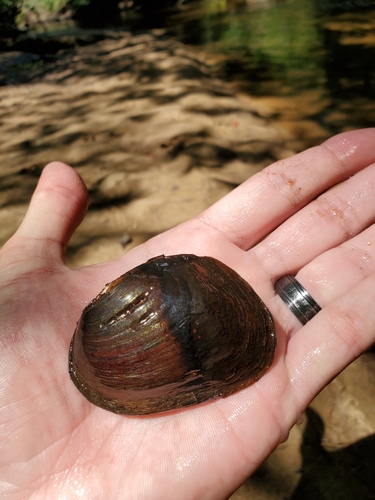


Purple Pigtoe
pustulosa succissa
The Purple Pigtoe is a remarkable freshwater mussel native to the pristine rivers and streams of the southeastern United States. Like other unionid mussels, it plays a vital role as an environmental biofilter, actively cleaning the water in its river ecosystems. These unassuming bivalves spend most of their long lives partially buried in sandy or gravelly riverbeds, quietly performing the essential task of maintaining aquatic health. Their fascinating reproductive cycle relies on a clever parasitic stage where microscopic larvae hitch a ride on the gills of specific host fish. This intricate connection makes them highly sensitive indicators of overall river health; finding a healthy population of Purple Pigtoe mussels is a strong sign of a clean, stable, and ecologically diverse river system.
Habitat: Found in medium to large rivers with moderate currents, typically resting in substrates of sand, gravel, or muddy sand.
This medium-sized freshwater mussel features a solid, somewhat rounded or subquadrate shell, typically reaching about 5 to 9 centimeters in length. The shell's exterior is yellowish-brown to dark brown, often adorned with characteristic pustules or bumps on the surface. Its most defining and beautiful feature is its striking nacre—the inner lining of the shell—which displays a deep purple, lavender, or iridescent violet hue, giving the species its evocative common name.
Category
InvertebrateRarity
Common
Danger
1/5 · Very low
Snaps
Be the first to snap!
The interior of the Purple Pigtoe's shell has a stunning, deep purple iridescent shine, which historically made it highly sought after for the pearl button industry.
These freshwater mussels can live for up to half a century, recording environmental and water quality changes within the growth rings of their shells.
To successfully reproduce, their microscopic larvae must attach to the gills of specific host fish to transform into juvenile mussels without harming the fish.
Uses a powerful, muscular foot to burrow deep into the riverbed, anchoring itself securely against swift currents and hiding from predators.
Possesses highly efficient siphon filtration, allowing it to process and clean several liters of river water every day.
Produces specialized larval glochidia that temporarily cling to host fish gills to disperse upstream before settling to the riverbed.
Filters organic matter, bacteria, and microscopic algae directly from the water column through its siphons.
Age differences: Larvae absorb nutrients from host fish tissue, while adults filter feed on organic particles.
Percina nigrofasciata
Serves as a host fish for the mussel's larval stage (glochidia), enabling dispersal upstream.

Ondatra zibethicus
Preys upon the adult mussels by crushing their shells to eat the soft inner body.
Chlamydomonas reinhardtii
Primary microscopic food source filtered from the water column.
No trait badges are assigned for this object yet.
No aliases listed yet.
Collections for this object will appear here as more themes are added.
Danger
1/5 · Very low
No special safety notes yet.
Compare body symmetry, shells, segments, legs, tentacles and how the animal moves. Invertebrates span many unrelated groups, so start with body structure. Invertebrate Identifier: upload a photo and compare the visible details.
5-9 cm
0.05-0.25 kg
20-50 years
Filters organic matter, bacteria, and microscopic algae directly from the water column through its siphons.
Found in medium to large rivers with moderate currents, typically resting in substrates of sand, gravel, or muddy sand.
Filtering
10000-90000
Zoom in to split clusters and explore where this object has been snapped.
Recent snaps will appear here as new observations are added.
Take the discovery with you
Snap it with Snappit to identify it, learn what makes it special, and add the discovery to your collection.