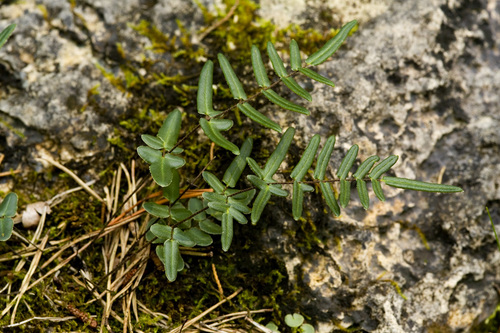


Purple-Stem Cliffbrake
pellaea atropurpurea
The Purple-Stem Cliffbrake (Pellaea atropurpurea) is an enchanting, resilient fern native to North America. Characterized by its contrasting dark purple-to-black stems and leathery gray-green fronds, this hardy perennial thrives in harsh, rocky environments where few other plants can survive. It is typically found clinging to limestone cliffs, calcareous ledges, and crumbling masonry. Unlike many moisture-loving ferns, the Purple-Stem Cliffbrake has adapted to arid microclimates, making it a true survivor of sun-baked rock faces. In addition to its striking aesthetic, this fern exhibits fascinating reproductive strategies. It is apogamous, meaning it can produce new sporophytes without the need for water-assisted fertilization. This remarkable evolutionary adaptation allows it to colonize dry vertical cliffs where standing water is rare, solidifying its place as a botanical marvel of the rocky wilderness.
Habitat: Typically found clinging to dry limestone cliffs, calcareous ledges, stony slopes, and old mortar walls.
This medium-sized fern grows in tufts, typically reaching heights of 10 to 50 cm. Its most distinguishing feature is its stiff, wiry, dark purple-brown to black stems (stipes and rachises) which are covered in fine, light-colored hairs. The fronds are once- or twice-pinnate, bearing leathery, lance-shaped pinnules that are a distinctive pale blue-green or gray-green color. The margins of the fertile pinnules are rolled inward (revolute), partially concealing the spore-producing sori underneath.
Category
PlantsRarity
Common
Danger
1/5 · Very low
Snaps
1
Because it relies on apogamy to reproduce, offspring are genetic clones of the parent plant, allowing it to bypass the need for free-standing water during reproduction.
Its scientific name 'atropurpurea' translates to 'dark purple', highlighting the beautiful, deep color of its wiry stems.
The common name 'Cliffbrake' refers to the fern's habit of growing on cliffs combined with the Middle English word 'brake', which means fern.
It can produce clones from its gametophyte stage without requiring water for fertilization, a critical adaptation for dry cliff faces.
The leathery texture and waxy coating of its blue-green pinnules help prevent water loss during periods of intense sun and drought.
Its fibrous root system can penetrate microscopic cracks in alkaline rocks, securing the plant against strong winds and absorbing scarce moisture.
Like most plants, the Purple-Stem Cliffbrake produces its own food through photosynthesis, utilizing sunlight, carbon dioxide, water, and essential soil minerals.
Asplenium resiliens
Often shares the exact same alkaline, calcareous rock crevice microhabitat, occasionally competing for space.

Odocoileus virginianus
Occasionally browses the foliage, although the tough, leathery fronds make it a minor food source.
Anguispira alternata
Co-occurs in limestone crevices where the snail grazes on micro-algae and detritus around the fern's roots, helping keep the microhabitat clean.
No trait badges are assigned for this object yet.
No aliases listed yet.
Collections for this object will appear here as more themes are added.
Danger
1/5 · Very low
No special safety notes yet.
The easiest way to identify Purple-Stem Cliffbrake is to use the Snappit nature identifier app.
10-50 cm
5-20 years
Like most plants, the Purple-Stem Cliffbrake produces its own food through photosynthesis, utilizing sunlight, carbon dioxide, water, and essential soil minerals.
Typically found clinging to dry limestone cliffs, calcareous ledges, stony slopes, and old mortar walls.
Zoom in to split clusters and explore where this object has been snapped.

West Virginia, US
You might spot Virginia Bluebells, Bloodroot, and Maidenhair Spleenwort.
View guide →

Arkansas, US
You might spot Rose Vervain, Ozark Leatherwood, and Trelease's Larkspur.
View guide →

Tennessee, US
You might spot Twinleaf, Purple-Stem Cliffbrake, and Trifoliate Orange.
View guide →

Missouri, US
You might spot Christmas Fern, Prairie Trillium, and Eastern Beebalm.
View guide →

New York, US
You might spot Spotted Lanternfly and Red-Tailed Hawk.
View guide →
Take the discovery with you
Snap it with Snappit to identify it, learn what makes it special, and add the discovery to your collection.











.jpg&width=800)



_001.jpg&width=800)




