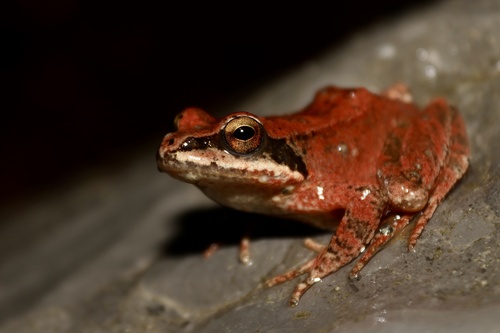


Pyrenean Frog
rana pyrenaica
The Pyrenean Frog (Rana pyrenaica) is a highly specialized, cold-water amphibian endemic to the pristine mountain torrents of the Pyrenees. First discovered by science in 1993, this species has evolved to thrive in fast-flowing, highly oxygenated streams fed by alpine snowmelt. They spend almost their entire lives clinging to submerged rocks, using their streamlined bodies to resist fierce mountain currents. Because of their strict reliance on unpolluted, cold water, they serve as excellent ecological indicators for the health of high-altitude aquatic ecosystems in Europe. Unfortunately, climate change, habitat loss, and introduced predatory fish pose severe threats to their survival.
Habitat: Found exclusively in cold, fast-flowing mountain streams with rocky substrates in the Pyrenees mountains.
This small frog measures between 3 and 5 centimeters in length and features a streamlined, flattened body designed to minimize water resistance. Its coloration is highly cryptic, ranging from olive-grey to rich ochre-brown, typically speckled with fine, dark spots that blend seamlessly with the gravelly riverbeds. A distinct dark mask-like stripe runs from the nostril through the eye, contrasted by a pale grey or yellowish throat. Its hind legs are long and powerful, featuring extensively webbed feet that provide maximum propulsion through turbulent mountain waters.
Category
AmphibiansRarity
Common
Danger
1/5 · Very low
Snaps
Be the first to snap!
The Pyrenean Frog was completely overlooked by modern biology and was only officially described as a distinct species in 1993.
To survive the freezing alpine winters, they hibernate under rocks at the bottom of fast-flowing streams where the water does not completely freeze.
Unlike many other frog species, males do not possess external vocal sacs and instead produce quiet, clicking calls underwater to attract mates.
Possesses highly webbed hind feet and a streamlined, flattened body that allow it to swim and climb against powerful mountain currents.
Specially adapted to remain active, forage, and lay eggs in near-freezing mountain waters that would incapacitate other amphibians.
Relies heavily on absorbing oxygen directly through its highly vascularized skin, enabling it to stay submerged for long periods in turbulent rapids.
Feeds primarily on a variety of small aquatic and terrestrial invertebrates found along rocky mountain stream banks.
Age differences: Tadpoles are herbivorous and detritivorous, scraping algae and organic debris from underwater rocks, whereas adults are purely insectivorous predators.
Calotriton asper
Preys on Pyrenean Frog larvae and small juveniles in the slow-moving pools of mountain streams.

Salmo trutta
An introduced predatory fish that feeds heavily on Pyrenean Frog tadpoles, significantly reducing their population.
Perla bipunctata
An abundant aquatic insect whose larvae serve as a primary food source for adult Pyrenean Frogs.
No trait badges are assigned for this object yet.
No aliases listed yet.
Collections for this object will appear here as more themes are added.
Danger
1/5 · Very low
No special safety notes yet.
Check the toe pads, leg length, eye markings, back pattern and body shape. Don't lean on color: some frogs change shade to match their surroundings. Frog Identifier: upload a photo and compare the visible details.
3-5 cm
0.004-0.012 kg
4-8 years
Feeds primarily on a variety of small aquatic and terrestrial invertebrates found along rocky mountain stream banks.
Found exclusively in cold, fast-flowing mountain streams with rocky substrates in the Pyrenees mountains.
Ambush
40-150
Zoom in to split clusters and explore where this object has been snapped.
Recent snaps will appear here as new observations are added.
Take the discovery with you
Snap it with Snappit to identify it, learn what makes it special, and add the discovery to your collection.