





Northern Zigzag Salamander
Plethodon dorsalis
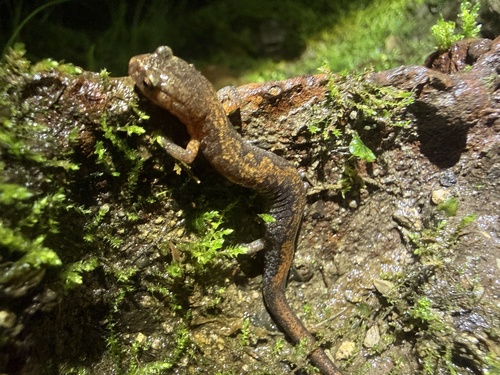
The Northern Zigzag Salamander is a small, colorful creature that loves to hide under rocks and leaves. It has a unique zigzag pattern on its back that helps it blend in with its forest home.
Habitat: Forests
The Northern Zigzag Salamander is a small, slender amphibian with a distinctive red, orange, or yellow "zigzag" stripe running down its back. This wavy stripe contrasts sharply with its dark brown to black body, making it look like a tiny lightning bolt.
Category
AmphibiansRarity
Common
Danger
1/5 · Very low
Snaps
4
Some can go months without food by slowing their metabolism!
These salamanders never drink water; they absorb it through their skin!
They don't have lungs, relying entirely on their damp skin to breathe!
They lay eggs underground and guard them until they hatch!
Northern Zigzag Salamander can detach its tail to escape predators, which then wiggles to distract attackers while the salamander slips away to safety.
Northern Zigzag Salamander has a cryptic zigzag pattern that helps them blend perfectly with leaf litter and moss, making it hard for predators to spot them.
Northern Zigzag Salamander has slightly noxious skin secretions that can deter some predators, helping them avoid being eaten.
Tiny salamanders munch on small insects and other invertebrates they find in the forest.
Formica fusca
A common prey item in their forest habitat.
Porcellionides pruinosus
Feeds on these small crustaceans in damp areas.
Thamnophis sirtalis
A primary predator in their natural environment.

Procyon lotor
Opportunistic predator that may find salamanders.
Solitary animals live alone for most of their lives, only interacting with others for mating or parental care.
Arboreal animals live primarily in trees, utilizing them for shelter, food, and protection from predators.
Camouflaged describes organisms that possess coloring or patterns that allow them to blend into their environment.
Colorful describes organisms or objects displaying a wide range of bright and distinct colors.

This trait identifies organisms whose diet primarily consists of insects and other small invertebrates.

Describes organisms that break down dead organic material, recycling nutrients back into the ecosystem.

Forest habitats are terrestrial environments dominated by dense tree cover, supporting a high diversity of plant and animal life.

Regenerative organisms possess the ability to regrow lost or damaged body parts, tissues, or organs.
No aliases listed yet.
Danger
1/5 · Very low
If you see a salamander, watch it from a distance and don't touch it. They are delicate and need to stay safe.
The easiest way to identify Northern Zigzag Salamander is to use the Snappit nature identifier app.
7-10 cm
0.002-0.005 kg
5-10 years
0.2 km/h
Tiny salamanders munch on small insects and other invertebrates they find in the forest.
Forests
Foraging
Zoom in to split clusters and explore where this object has been snapped.
Apr 3, 2026
Kentucky Down UnderPhoto attribution
(c) Nick Tobler (Cowturtle), some rights reserved (CC BY)
License: CC BY 4.0 ↗
Image may be shown cropped inside the card frame.
Kentucky, US
You might spot Kangaroos, Possums, Wombats, and Allies and Emu.
View guide →

Indiana, US
You might spot Painted Turtle and Virginia Springbeauty.
View guide →

Indiana, US
You might spot Eastern Newt and Dwarf Larkspur.
View guide →
Kentucky, US
You might spot Great Waterleaf, Lesser Celandine, and White-Tailed Deer.
View guide →
Take the discovery with you
Snap it with Snappit to identify it, learn what makes it special, and add the discovery to your collection.





.JPG&width=800)


.jpg&width=800)

