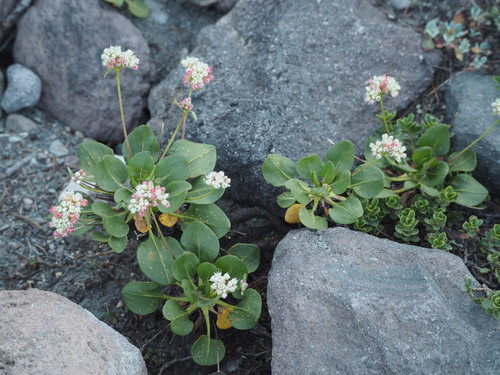


Pyrola-Leaf Buckwheat
eriogonum pyrolifolium
Pyrola-Leaf Buckwheat is a fascinating alpine perennial native to the high-elevation volcanic and rocky slopes of western North America, ranging from British Columbia through the Cascade Range and Sierra Nevada. This resilient plant forms low, sprawling mats or tight cushions that hug the ground, anchoring itself in loose volcanic ash, pumice, and gravelly scree. Despite the harsh, windswept environments it calls home, it plays an essential role as a pioneering species, helping to stabilize volatile soils and pave the way for other high-altitude vegetation. What makes this plant particularly captivating is its ability to bloom in some of the most barren landscapes on Earth, such as the slopes of Mount St. Helens. Its delicate, pom-pom-like flower clusters provide a striking contrast against the dark volcanic rock, serving as a vital oasis of nectar for alpine insects.
Habitat: Found on alpine and subalpine volcanic slopes, gravelly scree, pumice fields, and rocky ridges at high elevations.
This low-growing perennial reaches a modest height of 5 to 15 centimeters, forming a basal rosette of thick, leathery, oval to teardrop-shaped leaves that resemble those of the wintergreen genus Pyrola. The leaves are typically bright green to olive, often sporting a smooth or slightly fuzzy texture on the undersides. Rising above this foliage are leafless, reddish stems topped by dense, spherical flower heads. The individual tiny, bell-shaped flowers range in color from creamy white to pale pink or rose, often turning a deep reddish-brown as they mature and dry out.
Category
PlantsRarity
Common
Danger
1/5 · Very low
Snaps
1
Its scientific name 'pyrolifolium' means 'leaves like Pyrola' (wintergreen), referencing its round, leathery leaves.
The dried, reddish flower heads persist on the plant long after the blooming season ends, maintaining their shape even under early winter snow.
This plant was one of the few resilient survivor species to quickly recolonize the devastated pumice plains after the 1980 eruption of Mount St. Helens.
It is highly adapted to growing in loose, nutrient-poor volcanic ash and pumice, serving as one of the first plants to stabilize these hostile substrates.
Its leaves have a thick, leathery cuticle that reduces water loss in windswept, dry alpine environments.
It develops a sturdy, deep taproot that secures the plant in shifting talus and absorbs moisture from deep within rocky soils.
As a photoautotroph, this plant generates its own energy through photosynthesis, using sunlight, carbon dioxide, and water while absorbing essential minerals from the soil.
Ochotona princeps
Harvested by pikas for winter haypiles on rocky slopes.
Bombus occidentalis
Pollinated by the bee while it collects nectar.
No trait badges are assigned for this object yet.
No aliases listed yet.
Collections for this object will appear here as more themes are added.
Danger
1/5 · Very low
No special safety notes yet.
The easiest way to identify Pyrola-Leaf Buckwheat is to use the Snappit nature identifier app.
5-15 cm
5-20 years
As a photoautotroph, this plant generates its own energy through photosynthesis, using sunlight, carbon dioxide, and water while absorbing essential minerals from the soil.
Found on alpine and subalpine volcanic slopes, gravelly scree, pumice fields, and rocky ridges at high elevations.
Zoom in to split clusters and explore where this object has been snapped.

Oregon, US
You might spot White Pasqueflower and Clark's Nutcracker.
View guide →

California, US
You might spot Purple Mountain-Heath, Mountain Hemlock, and Satin Lupine.
View guide →

Washington, US
You might spot Cascade Golden-Mantled Ground Squirrel.
View guide →

Washington, US
You might spot Cascade Golden-Mantled Ground Squirrel.
View guide →
Take the discovery with you
Snap it with Snappit to identify it, learn what makes it special, and add the discovery to your collection.











.jpg&width=800)



_001.jpg&width=800)




