




Quaking Aspen
Populus tremula
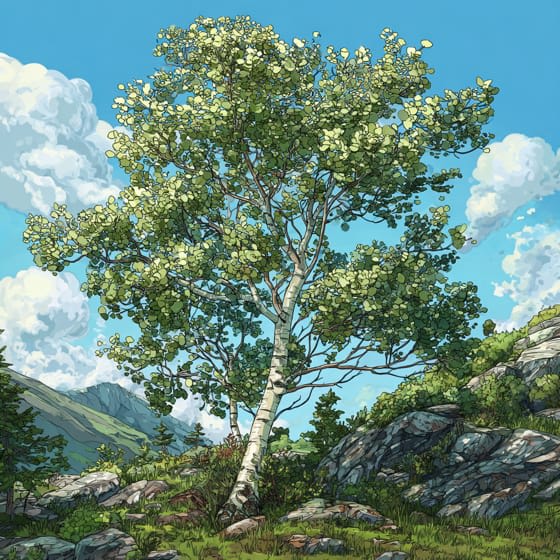
Quaking Aspen is known for its leaves that flutter in the breeze! This tree has white bark and grows tall and straight.
Habitat: Forests and hillsides
The Quaking Aspen has smooth, pale greenish-white bark, often marked with dark scars. Its small, rounded leaves, attached by flattened petioles, shimmer and "quake" distinctively in the slightest breeze, creating a beautiful silver-green display.
Category
TreesRarity
Common
Danger
1/5 · Very low
Snaps
1
After a wildfire, aspens often emerge first, helping restore life to the scorched land!
Aspen groves can be one of the largest and heaviest living things on Earth!
The 'quaking' sound of their leaves has earned them many nicknames, like 'whispering giant'.
Their white bark uses chlorophyll to make food, even in winter when leaves are gone.
Quaking Aspen can form vast underground networks, allowing hundreds of genetically identical trees to sprout from one root system.
Quaking Aspen has flattened leaf stems that make its leaves tremble, helping it efficiently capture sunlight and cool itself.
Quaking Aspen can rapidly resprout from its root system after devastating forest fires, quickly reclaiming burnt landscapes.
Deciduous plants periodically shed all their leaves, typically during autumn or dry seasons.
Shade tolerant plants are adapted to grow and thrive in areas with low light levels, requiring less direct sunlight.
Broadleaf trees are angiosperms characterized by flat, wide leaves that are typically shed annually in temperate climates.
Rapid growing plants exhibit accelerated growth rates, quickly increasing in size and biomass within a short period.

Forest habitats are terrestrial environments dominated by dense tree cover, supporting a high diversity of plant and animal life.
No aliases listed yet.
Danger
1/5 · Very low
Do not pick or eat anything you find. Some plants and mushrooms can be harmful.
The easiest way to identify Quaking Aspen is to use the Snappit nature identifier app.
15-30 m
5-10 m
Yes
30-60 cm
60-150 years
Forests and hillsides
Capsule
Zoom in to split clusters and explore where this object has been snapped.

Utah, US
You might spot Common Golden-Mantled Ground Squirrel and Steller's Jay.
View guide →

Utah, US
You might spot Common Golden-Mantled Ground Squirrel and Steller's Jay.
View guide →

Alaska, US
You might spot Cliff Swallow, Pretty Jacob's-Ladder, and Dwarf Fireweed.
View guide →

Montana, US
You might spot Great Blanketflower and Seven-Spotted Lady Beetle.
View guide →

Wyoming, US
You might spot Elk, American White Pelican, and Arrowleaf Balsamroot.
View guide →
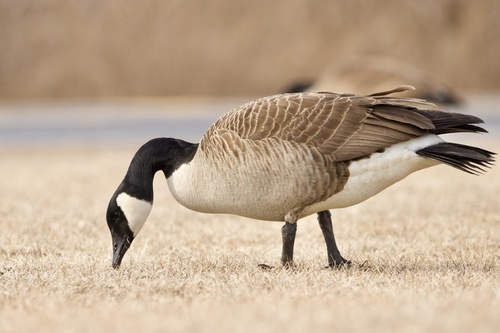
Nevada, US
You might spot Canada Goose, Antelope Bitterbrush, and Steller's Jay.
View guide →
Take the discovery with you
Snap it with Snappit to identify it, learn what makes it special, and add the discovery to your collection.