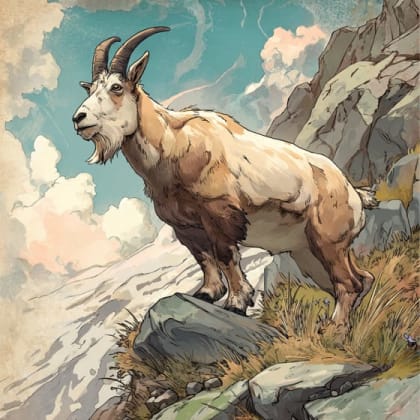





Mountain Goat
.jpg)
Nestled amidst the ancient granite peaks of the Black Hills in South Dakota, Mount Rushmore National Memorial stands as an unparalleled tribute to American democracy.
Nestled amidst the ancient granite peaks of the Black Hills in South Dakota, Mount Rushmore National Memorial stands as an unparalleled tribute to American democracy. This awe-inspiring site features the colossal 60-foot faces of four iconic U.S. presidents—George Washington, Thomas Jefferson, Theodore Roosevelt, and Abraham Lincoln—carved directly into the mountainside. Representing the nation's birth, growth, development, and preservation, these monumental sculptures are a testament to human ingenuity and artistic vision, making the memorial a truly unique and powerful symbol.
Beyond the iconic carving, the memorial's surrounding landscape offers a vibrant natural experience. The Black Hills are home to a diverse array of flora and fauna that visitors can observe. Keep an eye out for curious Least Chipmunks and swift American Red Squirrels darting among the Rocky Mountains Ponderosa Pine and quaking aspen trees. Overhead, you might spot a Dark-eyed Junco, while larger mammals like Mule Deer and even Mountain Goats traverse the rugged terrain. The area also boasts a variety of wildflowers, including the vibrant showy milkweed, wild bergamot, and upright prairie coneflower, adding splashes of color to the scenic trails.
Visiting Mount Rushmore is an unforgettable experience that deeply connects you with both American history and the wild beauty of the Black Hills. The sheer scale of the sculpture, combined with the tranquil natural surroundings, creates a profound sense of wonder and reflection. Whether you're admiring the intricate details of the presidential faces, exploring the natural trails, or witnessing the moving Evening Lighting Ceremony, the memorial offers a memorable journey into the heart of the nation's heritage and its stunning natural landscapes. Don't forget to bring the Snappit nature identification app along to scan local species.
The genesis of Mount Rushmore began in 1923 when South Dakota historian Doane Robinson proposed a grand sculpture in the Black Hills to boost tourism. He envisioned figures of Old West heroes, but Danish-American sculptor Gutzon Borglum, chosen for the project, had a more ambitious vision: a monumental tribute to four American presidents. Borglum selected George Washington, Thomas Jefferson, Theodore Roosevelt, and Abraham Lincoln to symbolize the founding, expansion, development, and preservation of the United States. Construction commenced in 1927 and, despite numerous challenges and the use of dynamite to carve away 450,000 tons of rock, was largely completed by 1941. Approximately 400 workers toiled on the mountain, often in perilous conditions. Gutzon Borglum tragically passed away just months before the memorial's completion, with his son, Lincoln Borglum, overseeing the final stages of the project. It's important to note that the memorial was carved into what the Lakota Sioux called "Six Grandfathers Mountain," a site sacred to them, and its construction on this land remains a point of historical controversy.
Walk the **Presidential Trail**, a 0.6-mile loop that gets you closer to the base of the mountain and offers various viewing angles (note: it includes 422 stairs, but a significant portion is accessible).
Attend a **ranger talk** or program to learn more about the memorial's history, creation, and the local ecology.
Experience the **Evening Lighting Ceremony**, held nightly from late May through September, which illuminates the sculpture accompanied by a patriotic program.
Explore the **Exhibition Hall** within the Visitor Center, showcasing videos, photographs, and prototypes.
Look for wildlife! Keep an eye out for Least Chipmunks, American Red Squirrels, and Dark-eyed Juncos on the trails, and possibly Mule Deer or Mountain Goats in the distance.
Summer: Expect full crowds and amenities. The Evening Lighting Ceremony is a daily highlight. May and June are typically the wettest months.
Spring/Fall: Enjoy milder weather and beautiful natural scenery. Early morning and late afternoon are prime for wildlife spotting.
Winter: Offers a quieter, more solitary experience. While facilities may have reduced hours and some trails might be snow-covered, the memorial is still illuminated at sunset.
Mount Rushmore National Memorial is highly accessible. Accessible parking is available in the parking garage, with elevators providing access to all levels. A drop-off area is located directly in front of the main entrance. Loaner wheelchairs are available at the Information Center. The **Avenue of Flags** and **Grand View Terrace** are barrier-free. The first 0.2 miles of the **Presidential Trail** are paved and wheelchair accessible, offering excellent views. Elevators also connect the Grand View Terrace to the Lincoln Borglum Visitor Center and Amphitheater. The Carver's Café and gift shop are wheelchair accessible.
The **Grand View Terrace** offers the quintessential panoramic view of the presidential carvings. The **Avenue of Flags** leads to this terrace, featuring 56 flags representing U.S. states and territories. The **Lincoln Borglum Visitor Center** provides historical context through exhibits and a film. Don't miss the **Sculptor's Studio** for insights into the carving process and a scale model.
Each card links to a full Explore page with photos, traits, and fun facts.
Start with the big picture, then zoom in to explore individual wildlife observations around this place.
Visit Early or Late
Arrive early in the morning (before 9 AM) for the best photographs with ideal lighting, fewer crowds, and cooler temperatures during warmer months. Late afternoon also offers good light and can lead into the Evening Lighting Ceremony.
Keep Your Parking Ticket
The parking fee of $10 per private vehicle is valid for one year. If you plan to return later in the day or within the year, hold onto your ticket.
Stay for the Lighting Ceremony
From late May through September, the Evening Lighting Ceremony is a moving and patriotic experience that should not be missed. Check the schedule upon arrival.
Walk the Presidential Trail
Even if you can't complete the entire loop with its stairs, walk the accessible paved section for unique perspectives and closer views of the carvings.
Look for Wildlife
While exploring, particularly on the trails or in quieter areas, keep an eye out for local wildlife like Least Chipmunks, American Red Squirrels, Mule Deer, and various birds. Binoculars or a telephoto lens are recommended for ethical wildlife viewing.
Dress in Layers
Mount Rushmore is at an elevation of 5,680 feet, and weather in the Black Hills can change rapidly. Dressing in layers will ensure comfort throughout the day.
Oct 27, 2025
Oct 27, 2025
Oct 7, 2025
Jul 26, 2025
Jul 15, 2025

Maryland, US
You might spot White-Tailed Deer and Eastern Gray Squirrel.
View guide →
.jpg)
District of Columbia, US
You might spot Eastern Gray Squirrel, Duck, and House Sparrow.
View guide →

Illinois, US
You might spot American Robin, Canada Goose, and House Sparrow.
View guide →

Virginia, US
You might spot Spotted Lanternfly and Northern Cardinal.
View guide →
Take the discovery with you
Identify the wildlife you spot, learn as you go, and keep a collection of the adventure.