
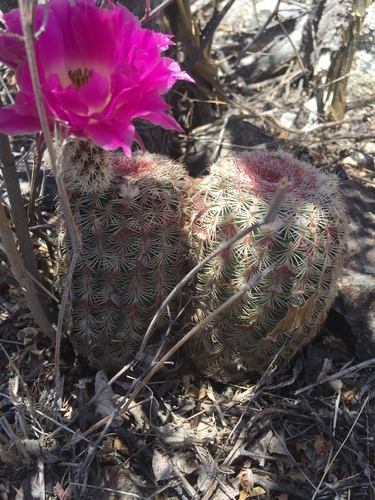


Rainbow Hedgehog Cactus
echinocereus rigidissimus
The Rainbow Hedgehog Cactus is a small, solitary desert succulent famed for its spectacular visual design and beautiful symmetry. Native to the rocky slopes of the Sonoran and Chihuahuan deserts, this slow-growing plant does not produce offshoots, maintaining a single, rigid, cylindrical column throughout its life. It is most famous for its bands of beautifully colored spines that wrap tightly around its body, shifting in hue based on seasonal growth patterns. In late spring, this remarkable cactus crowns itself with enormous, brilliant magenta-pink blossoms that open during the day, creating a breathtaking contrast with the harsh, dry environment it inhabits.
Habitat: Found on gravelly limestone slopes, rocky hillsides, and semi-desert grasslands at elevations between 1,200 and 1,800 meters.
This cactus features a solitary, erect, cylindrical stem that typically grows 10 to 30 centimeters tall and 5 to 10 centimeters wide. Its green flesh is completely hidden beneath a dense layer of comb-like (pectinate) radial spines that lie flat against the plant's surface. These spines form distinct, horizontal bands of rose-pink, reddish-purple, pale yellow, and creamy white. In late spring, it produces large, funnel-shaped flowers at its crown, measuring up to 10 centimeters in diameter, characterized by bright magenta petals with a distinct, creamy-white throat and lime-green stigma lobes.
Category
PlantsRarity
Common
Danger
1/5 · Very low
Snaps
Be the first to snap!
The alternating bands of color on the cactus serve as a historical weather diary; wetter seasons yield brighter pink bands, while dry spells produce paler, cream-colored rings.
The species name 'rigidissimus' translates to 'very rigid', referring to both the stiff, unyielding nature of the plant's stem and its sharp, comb-like spines.
Unlike many related species of hedgehog cacti, the Rainbow Hedgehog Cactus is completely solitary and almost never produces offsets or 'pups' from its base.
The comb-like, interlocking spines lie completely flat against the stem, forming a dense reflective barrier that shields the cactus from intense desert heat and minimizes water evaporation.
It opens its stomata exclusively at night to absorb carbon dioxide, storing it as malic acid to complete photosynthesis during the day without losing moisture to the dry wind.
The color intensity of the developing spines changes based on water availability and temperature, resulting in natural, band-like rings that chronicle past growing seasons.
As a photosynthetic plant, it manufactures its own chemical energy from sunlight, water, and atmospheric carbon dioxide while drawing essential minerals from rocky desert soils.
Diadasia opuntiae
Native bees visit the large, nectar-rich flowers during spring, facilitating cross-pollination essential for seed production.

Melanerpes uropygialis
Avian desert species feed on the sweet, fleshy red fruits and disperse the tiny black seeds across rocky substrates.
No trait badges are assigned for this object yet.
No aliases listed yet.
Collections for this object will appear here as more themes are added.
Danger
1/5 · Very low
No special safety notes yet.
Compare leaf arrangement, rosette shape, ribs, spines and flowers. Keep in mind that drought and strong sun can shift a plant's color and shape. Succulent Identifier: upload a photo and compare the visible details.
10-30 cm
0.2-1.5 kg
15-30 years
As a photosynthetic plant, it manufactures its own chemical energy from sunlight, water, and atmospheric carbon dioxide while drawing essential minerals from rocky desert soils.
Found on gravelly limestone slopes, rocky hillsides, and semi-desert grasslands at elevations between 1,200 and 1,800 meters.
Zoom in to split clusters and explore where this object has been snapped.
Recent snaps will appear here as new observations are added.
Take the discovery with you
Snap it with Snappit to identify it, learn what makes it special, and add the discovery to your collection.


















