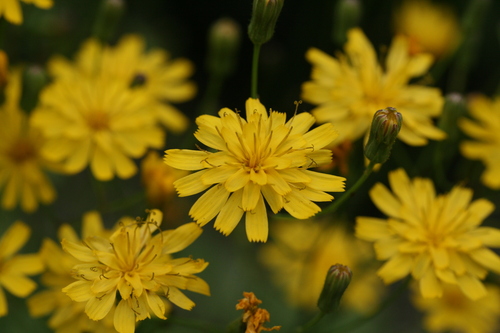


Rattlesnakeweed
hieracium venosum
Rattlesnakeweed (Hieracium venosum) is a captivating perennial wildflower native to the dry, open woodlands of eastern North America. A member of the aster family, this plant is most famous not for its flowers, but for its incredibly striking basal foliage. The leaves lie flat against the forest floor in a neat rosette, boasting deep purple-red veins that map across the green surface like a complex web. This unique venation pattern gave rise to the folk belief that the plant could cure snakebites, earning it its common name. During the late spring and summer, Rattlesnakeweed sends up slender, leafless stalks topped with loose clusters of bright yellow, dandelion-like flower heads. These blossoms attract a variety of native bees and other pollinators, making it an important ecological player in sandy, acidic, or nutrient-poor soils where other plants struggle to thrive.
Habitat: Typically found in dry, open deciduous or mixed pine woodlands, sandy clearings, and acidic barrens.
This plant is easily identified by its basal rosette of oblong, hairy leaves, which are 5 to 15 centimeters long and feature prominent, dark purple-red veins along the midrib and lateral pathways. The upper leaf surfaces are covered in long, scattered hairs. From the center of this rosette rises a smooth, slender, purplish stem, largely devoid of leaves, reaching 20 to 60 centimeters in height. It terminates in a branched, open cluster of small, bright yellow flower heads, each about 1.5 centimeters wide and resembling miniature dandelions.
Category
PlantsRarity
Common
Danger
1/5 · Very low
Snaps
4
Its common name, Rattlesnakeweed, comes from an old folk remedy belief that the purple leaf veins resembled snake scales, signaling its potential to cure snakebites.
The species is highly allelopathic, meaning it can release chemical compounds into the soil to inhibit the growth of competing plants nearby.
Unlike many forest plants, it prefers acidic soils and is often found growing alongside blueberries and mountain laurel.
The distinct purple-red veins contain anthocyanins that help protect the plant from light stress and may deter herbivores by making the leaves look less appetizing.
Features a deep taproot and fine leaf hairs that reduce moisture loss, allowing the plant to thrive in dry, nutrient-poor, sandy soils.
Produces seeds equipped with a feathery pappus that catches air currents, allowing the species to colonize distant forest clearings.
As an autotrophic plant, it produces its own food using sunlight, carbon dioxide, water, and minerals absorbed through its root system.
Bombus pensylvanicus
The bright yellow flowers provide pollen and nectar to native bumblebees during the spring and summer months.

Odocoileus virginianus
The basal leaves are occasionally browsed by herbivores, though the long hairs provide some defense.
No trait badges are assigned for this object yet.
No aliases listed yet.
Collections for this object will appear here as more themes are added.
Danger
1/5 · Very low
No special safety notes yet.
The easiest way to identify Rattlesnakeweed is to use the Snappit nature identifier app.
20-60 cm
0.01-0.05 kg
2-8 years
As an autotrophic plant, it produces its own food using sunlight, carbon dioxide, water, and minerals absorbed through its root system.
Typically found in dry, open deciduous or mixed pine woodlands, sandy clearings, and acidic barrens.
Zoom in to split clusters and explore where this object has been snapped.

Pennsylvania, US
You might spot Large Yellow Underwing and Eastern Black Carpenter Ant.
View guide →

Michigan, US
You might spot Eastern Skunk Cabbage and Kirtland's Warbler.
View guide →

Georgia, US
You might spot Joro Spider, American Sweetgum, and American Tuliptree.
View guide →

Georgia, US
You might spot Pond Slider, Mountain Laurel, and Little Brown Jugs.
View guide →

Georgia, US
You might spot Pond Slider, Mountain Laurel, and Little Brown Jugs.
View guide →

Virginia, US
You might spot Squareback Marsh Crab and American Trumpet Vine.
View guide →
Take the discovery with you
Snap it with Snappit to identify it, learn what makes it special, and add the discovery to your collection.










.jpg&width=800)



_001.jpg&width=800)




