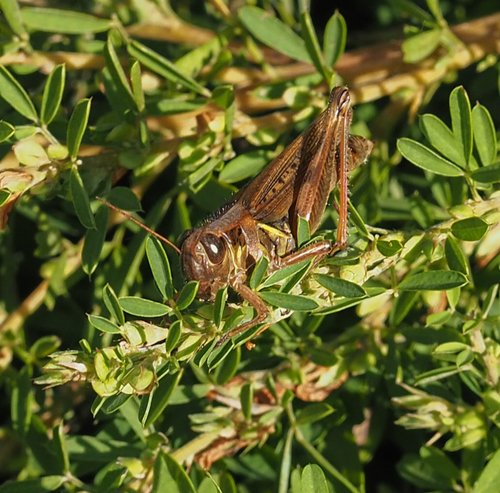


Red-Legged Grasshopper
melanoplus femurrubrum
The Red-Legged Grasshopper (Melanoplus femurrubrum) is one of the most common and widely distributed grasshopper species in North America. Known for its remarkable jumping abilities and its distinct reddish hind legs, it is a familiar sight in meadows, fields, and along roadsides throughout its range. This generalist herbivore plays a significant role in many ecosystems, serving as a primary consumer of various plants and a food source for numerous predators. Its life cycle, from egg to nymph to winged adult, is completed within a single warm season, making it a prominent insect from late spring through autumn.
Habitat: Found in open, sunny environments such as meadows, agricultural fields, pastures, roadsides, and disturbed grassy areas.
This medium-sized grasshopper typically measures between 1.5 to 3 cm in length. Its body color can vary from greenish-brown to dark brown, often with darker markings along its back. The most distinctive feature, and the origin of its common name, is the bright reddish coloration found on the lower part of its hind legs (tibiae). Adults possess fully developed wings, allowing for strong flight, and a robust body structure adapted for powerful leaps. Males are generally smaller than females.
Category
InsectsRarity
Common
Danger
1/5 · Very low
Snaps
Be the first to snap!
A single female Red-Legged Grasshopper can lay several egg pods, each containing dozens of eggs, throughout the late summer and fall.
Red-Legged Grasshoppers are an important part of the food web, serving as a vital protein source for birds, small mammals, reptiles, amphibians, and other invertebrates.
The species overwinters in the egg stage, with nymphs emerging in the spring and developing into adults by mid-summer.
Their reddish hind tibiae (shins) are a key identification feature and can be seen when they jump or fly, contrasting with their generally brown or green bodies.
Red-legged grasshoppers possess strong, muscular hind legs capable of propelling them many times their body length, an essential adaptation for evading predators.
Males produce distinct sounds by rubbing their hind legs against their forewings (stridulation), used primarily to attract mates and establish territory.
As polyphagous herbivores, they can feed on a wide variety of grasses, forbs, and crop plants, allowing them to thrive in diverse vegetative environments.
The Red-Legged Grasshopper is a generalist herbivore, consuming a wide array of plant material. They are known to feed on both grasses and broad-leafed plants, often demonstrating a preference for certain species depending on availability.

Poa pratensis
Primary food source
Turdus migratorius
Common predator

Argiope aurantia
Common predator
Tachinidae spp.
Host for parasitic larvae
No trait badges are assigned for this object yet.
No aliases listed yet.
Collections for this object will appear here as more themes are added.
Danger
1/5 · Very low
No special safety notes yet.
Look for six legs, antennae, three body sections and the shape of the wings. Beetles have hardened front wings; flies have just one working pair. Tiny insects may need a close view before their group is clear. Insect Identifier: upload a photo and compare the visible details.
1-3 cm
3-5 cm
0.0005-0.003 kg
0-1 years
The Red-Legged Grasshopper is a generalist herbivore, consuming a wide array of plant material. They are known to feed on both grasses and broad-leafed plants, often demonstrating a preference for certain species depending on availability.
Found in open, sunny environments such as meadows, agricultural fields, pastures, roadsides, and disturbed grassy areas.
Grazing
Zoom in to split clusters and explore where this object has been snapped.
Recent snaps will appear here as new observations are added.
Take the discovery with you
Snap it with Snappit to identify it, learn what makes it special, and add the discovery to your collection.