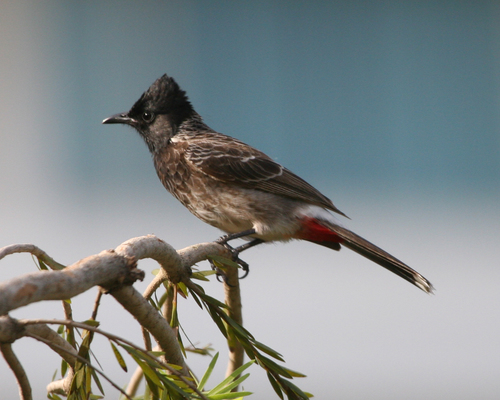


Red-Vented Bulbul
pycnonotus cafer
The Red-Vented Bulbul is an energetic, highly adaptable songbird native to the Indian subcontinent and parts of Southeast Asia. Renowned for its bold personality and familiar presence, this species has successfully integrated into various human-altered landscapes, ranging from bustling urban gardens to agricultural fields. They are highly social birds, frequently seen in pairs or small flocks, constantly moving and communicating with cheerful, metallic calls. Beyond its native range, the Red-Vented Bulbul has gained notoriety as one of the world's most successful invasive species. It has established feral populations in Hawaii, the Middle East, and various Pacific islands. While appreciated by some for its lively demeanor and insect-controlling habits, its voracious appetite for fruit and rapid seed dispersal makes it a significant agricultural pest and a threat to native ecosystems in its introduced habitats.
Habitat: Found in open scrublands, cultivated plains, and light forests, often perching in bushes or low trees.
This medium-sized bird measures roughly 20 centimeters in length and is easily identified by its distinctive, short erectile crest and solid black head. The body is primarily dark smoky-brown or blackish, with a lighter, scaled pattern visible on the breast and back. Its most striking feature—and the source of its name—is the vivid crimson-red patch located just under the base of its dark tail, known as the vent. In flight, a conspicuous white rump patch becomes highly visible. The tail itself is blackish with bold white tips, and they possess a relatively robust, dark bill adapted for both fruit-eating and insect-catching.
Category
BirdsRarity
Common
Danger
1/5 · Very low
Snaps
Be the first to snap!
Despite their small size, they have been observed preying on small geckos and are capable of consuming certain toxic plants that deter other birds.
In 19th-century India, these birds were prized for their fiery temperament and were tethered by a string to their owners' fingers for local bird-fighting matches.
The Red-Vented Bulbul is listed by the IUCN as one of the world's 100 worst invasive alien species because it outcompetes native birds and spreads the seeds of invasive weeds.
Their prominent white rump patch serves as a visual signal to other flock members when they suddenly take flight to escape predators.
Highly adaptable in its diet, it seamlessly switches between fruits, nectar, and insects, allowing it to thrive in diverse and foreign environments.
It has a short digestive tract, allowing it to pass seeds intact within minutes, acting as a major propagator of both native plants and invasive weeds.
Pairs and small flocks fiercely defend their territory, aggressively mobbing much larger predators like snakes, crows, and birds of prey to drive them away.
Feeds opportunistically on a wide array of fruits, berries, nectar, and insects.
Age differences: Nestlings are fed a highly protein-rich diet consisting almost exclusively of insects before transitioning to a more fruit-heavy adult diet.

Lantana camara
The bulbul rapidly consumes and disperses the seeds of this notorious invasive plant, inadvertently helping it spread.
Accipiter badius
This small raptor frequently hunts bulbuls in open woodlands and urban edges.
Clamator jacobinus
This cuckoo species is known to lay its eggs in the nests of bulbuls, tricking them into raising its young.
No trait badges are assigned for this object yet.
No aliases listed yet.
Collections for this object will appear here as more themes are added.
Danger
1/5 · Very low
No special safety notes yet.
Compare the silhouette, bill shape, tail length, wing bars and markings around the eyes. The same small brown bird at your feeder can look quite different in breeding plumage, winter plumage or its first year. Bird Identifier: upload a photo and compare the visible details.
20-22 cm
28-32 cm
0.026-0.045 kg
4-11 years
Feeds opportunistically on a wide array of fruits, berries, nectar, and insects.
Found in open scrublands, cultivated plains, and light forests, often perching in bushes or low trees.
Foraging
Zoom in to split clusters and explore where this object has been snapped.
Recent snaps will appear here as new observations are added.

Hawaii, US
You might spot Red-Crested Cardinal and Zebra Dove.
View guide →

Hawaii, US
You might spot Red-Crested Cardinal and Zebra Dove.
View guide →

Hawaii, US
You might spot Red-Crested Cardinal and Zebra Dove.
View guide →

Hawaii, US
You might spot Spotted Dove, Zebra Dove, and Java Sparrow.
View guide →

Hawaii, US
You might spot Zebra Dove and Red-Crested Cardinal.
View guide →

Hawaii, US
You might spot Red-Crested Cardinal and Zebra Dove.
View guide →
Take the discovery with you
Snap it with Snappit to identify it, learn what makes it special, and add the discovery to your collection.