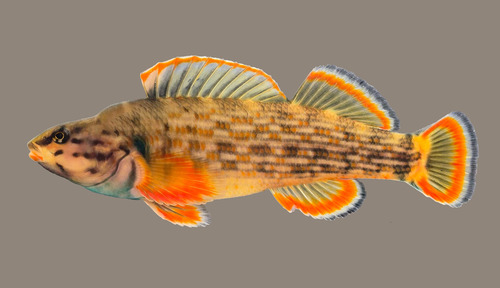


Redline Darter
nothonotus rufilineatus
The Redline Darter (Nothonotus rufilineatus) is a captivating freshwater fish native to the clear, rocky streams of the southeastern United States. Renowned for its vibrant coloration, particularly in breeding males, this small species plays a crucial role in its aquatic ecosystems as a benthic insectivore. Darters, in general, are known for their unique bottom-dwelling lifestyle, often 'darting' between rocks rather than swimming continuously. The Redline Darter exemplifies this behavior, utilizing its cryptic patterns and quick movements to navigate swift currents and ambush small invertebrates. Its presence is often an indicator of good water quality, making it a beloved species among naturalists and conservationists.
Habitat: Found in clear, cool, moderate to swift-flowing streams and small to medium-sized rivers, typically inhabiting rocky riffles and runs with gravel or cobble substrates.
The Redline Darter is a slender, elongated fish typically ranging from 5 to 7 centimeters in length. Breeding males are particularly striking, showcasing a brilliant blue-green body adorned with several distinct red-orange horizontal lines or spots along their flanks. Their fins, especially the dorsal and anal fins, are often edged or patterned with vibrant red, blue, and black bands. Females and non-breeding males are more subdued, exhibiting mottled brown and olive patterns with less intense coloration, providing effective camouflage against the rocky stream beds. They possess two distinct dorsal fins, characteristic of many darter species.
Category
FishRarity
Common
Danger
1/5 · Very low
Snaps
Be the first to snap!
Males are known to become highly territorial during the spawning season, vigorously defending their chosen nesting sites under rocks from other males.
Redline Darters spend most of their lives on the bottom of streams and rivers, 'walking' on their pectoral fins and only darting short distances when necessary.
The 'Redline' in its name refers to the distinctive red-orange lines or spots that adorn the flanks of breeding males, making them one of the most colorful darter species.
Their presence is often used as an indicator species for stream health, as they require clear, oxygen-rich waters with stable gravel substrates to thrive.
The Redline Darter possesses a mottled coloration that allows it to blend seamlessly with the rocky and gravelly stream beds, helping it avoid predators and ambush prey effectively.
Unlike many fish that swim continuously, darters exhibit a characteristic 'darting' behavior, using quick bursts of movement to move between rocks and hide from threats or catch unsuspecting invertebrates.
During spawning, females lay adhesive eggs on the undersides of rocks and pebbles, which are then fertilized and often guarded by the territorial males, increasing the survival rate of the offspring.
The Redline Darter is a specialized insectivore, primarily feeding on a variety of aquatic insect larvae and small invertebrates found on the stream bottom.

Ephemeroptera
A primary food source for the Redline Darter, its larvae are abundant in the same habitats.

Trichoptera
Larval forms are a significant part of the Redline Darter's diet.

Micropterus dolomieu
A common predator of darters, often sharing the same stream systems.
Etheostoma blennioides
Another benthic fish species that might compete for similar food resources and microhabitats.
No trait badges are assigned for this object yet.
No aliases listed yet.
Collections for this object will appear here as more themes are added.
Danger
1/5 · Very low
No special safety notes yet.
Look at body shape, where the fins sit and their outline, mouth position, stripes and spots. Young fish and breeding adults can wear different patterns, and aquarium color varieties can look nothing like wild fish. Fish Identifier: upload a photo and compare the visible details.
5-7 cm
0.003-0.007 kg
2-3 years
The Redline Darter is a specialized insectivore, primarily feeding on a variety of aquatic insect larvae and small invertebrates found on the stream bottom.
Found in clear, cool, moderate to swift-flowing streams and small to medium-sized rivers, typically inhabiting rocky riffles and runs with gravel or cobble substrates.
Foraging
50-300
Zoom in to split clusters and explore where this object has been snapped.
Recent snaps will appear here as new observations are added.
Take the discovery with you
Snap it with Snappit to identify it, learn what makes it special, and add the discovery to your collection.