
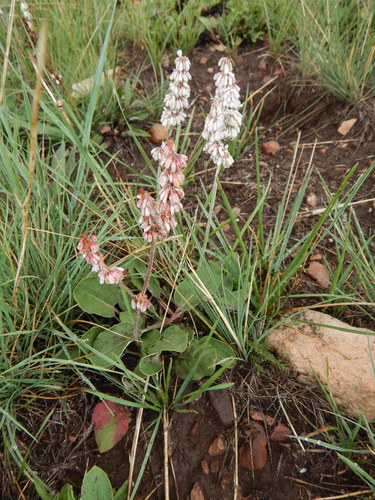


Redroot Buckwheat
eriogonum racemosum
Redroot Buckwheat (Eriogonum racemosum) is an attractive perennial herb native to the dry, mountainous regions of the western United States. Highly adapted to arid environments, it is a key member of pinyon-juniper woodlands and ponderosa pine communities. This plant is easily recognized by its tall, leafless, wand-like stems rising gracefully from a dense basal rosette of woolly green leaves, culminating in delicate racemes of tiny flowers. Beyond its striking minimalist appearance, Redroot Buckwheat serves as a vital ecological cornerstone. It stabilizes loose, sandy soils on exposed slopes and provides essential nourishment for a wide array of native pollinators, including bees, butterflies, and beetles. Its resilient nature allows it to thrive in rugged conditions where few other plants can survive, making it an inspiring sight for hikers exploring the canyonlands and high plateaus.
Habitat: Found in dry, open habitats including pinyon-juniper woodlands, ponderosa pine forests, and rocky slopes at elevations between 1,500 and 3,000 meters.
This perennial herb features a basal rosette of oval to oblong leaves, which are smooth and green on top but covered with dense, white woolly hairs underneath. From this rosette, slender, naked, and frequently branched flowering stems rise to a height of 30 to 100 centimeters. The tiny, tubular flowers lack true petals and are arranged in loose racemes along the upper branches; they range in color from chalky white to soft baby pink or deep rose, often drying to a rustic reddish-brown.
Category
PlantsRarity
Common
Danger
1/5 · Very low
Snaps
Be the first to snap!
Indigenous tribes historically utilized infusions of the red roots for medicinal purposes, including treating colds, stomach aches, and tuberculosis.
The common name 'redroot' refers to the plant's thick, woody taproot, which exhibits a distinct reddish-orange hue when peeled or cut.
The dried flower stalks of Redroot Buckwheat persist through the winter, providing structural food resources and cover for small sub-alpine wildlife.
Possesses a deep, robust woody taproot that penetrates deep into arid soils to access hidden moisture reserves.
The undersides of the leaves are covered in dense, woolly white hairs that reflect harsh sunlight and reduce transpiration.
Helps stabilize loose, sandy slopes and volcanic soils, preventing erosion in fragile high-elevation environments.
Redroot Buckwheat is a photoautotrophic plant that generates its own nutrients using sunlight, water, and carbon dioxide through photosynthesis.

Halictus rubicundus
Provides nectar and pollen, receiving pollination services in return.
Callophrys sheridanii
Serves as a critical larval host plant where caterpillars feed on the leaves.

Odocoileus hemionus
Occasionally browses on the foliage and flowering stems during the summer months.
No trait badges are assigned for this object yet.
No aliases listed yet.
Collections for this object will appear here as more themes are added.
Danger
1/5 · Very low
No special safety notes yet.
Start with the whole plant, then compare leaf arrangement, leaf edges, stems and any flowers or fruit. Opposite leaves grow in pairs; alternate leaves come one at a time along the stem. These details tell you far more together than a single green leaf does. Plant Identifier: upload a photo and compare the visible details.
30-100 cm
3-10 years
Redroot Buckwheat is a photoautotrophic plant that generates its own nutrients using sunlight, water, and carbon dioxide through photosynthesis.
Found in dry, open habitats including pinyon-juniper woodlands, ponderosa pine forests, and rocky slopes at elevations between 1,500 and 3,000 meters.
Zoom in to split clusters and explore where this object has been snapped.
Recent snaps will appear here as new observations are added.
Take the discovery with you
Snap it with Snappit to identify it, learn what makes it special, and add the discovery to your collection.


















