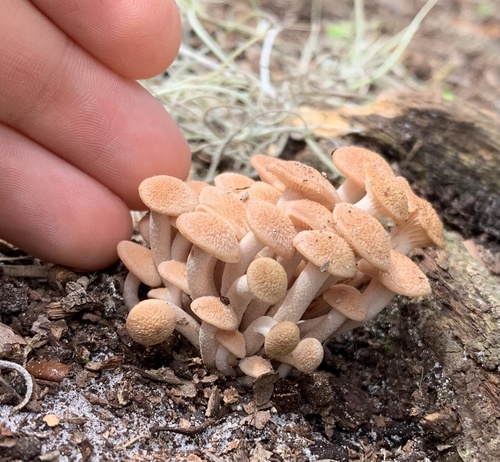


Ringless Honey Mushroom
desarmillaria caespitosa
The Ringless Honey Mushroom (Desarmillaria caespitosa) is a fascinating and abundant mushroom known for its tight, sprawling clusters that carpet the bases of trees and decaying stumps. Unlike its close relatives in the Armillaria genus, this species completely lacks a ring (annulus) on its stem, a key feature that gives it its common name. Operating as both a saprotroph and a parasite, it plays a vital dual role in forest ecosystems by decomposing dead wood and sometimes attacking stressed living hardwood trees, particularly oaks. To mushroom foragers, these mushrooms are highly recognizable due to their crowded, cespitose growth pattern, often appearing in dramatic flushes of hundreds of individual fruiting bodies after autumn rains.
Habitat: Found in deciduous forests, parks, and suburban lawns, growing in large clusters at the base of living hardwood trees, stumps, or from buried roots.
This mushroom grows in dense, crowded clusters sharing a common base. The caps are typically 2 to 10 centimeters broad, convex when young before flattening out, with dry surfaces covered in tiny, dark, hair-like scales, especially near the center. Cap colors range from honey-yellow to tan or reddish-brown. The gills are whitish to pale yellow and run slightly down the fibrous, tough stems, which completely lack any ring or veil remnants. It produces a distinctive white spore print.
Category
FungiRarity
Common
Danger
1/5 · Very low
Snaps
3
Although they appear to grow on soil or lawns, they are actually feeding on buried tree roots or decaying wood hidden just beneath the surface.
This species was historically classified under the genus Armillaria as Armillaria tabescens, but recent genetic work moved North American specimens to the genus Desarmillaria.
Unlike many of its close cousins in the Armillaria genus, the Ringless Honey Mushroom does not possess a ring on its stalk, making it much easier to identify.
Secretes powerful enzymes that break down lignin and cellulose in wood, reducing tough tree structures to soft, nutrient-rich soil.
Grows in highly crowded, interconnected clusters sharing a single point of origin, allowing them to rapidly burst through soil and bark to release spores.
Can transition from a harmless decomposer to an active parasite, invading the root systems of weakened trees to acquire nutrients.
Functions as a decomposer of dead hardwood and a parasite on weakened living trees, absorbing nutrients directly through its underground mycelial network.

Quercus alba
Invades and feeds on the root system of this live hardwood tree, causing root rot.
Mycetophila fungorum
Provides food and breeding ground for the larvae of this insect.

Trametes versicolor
Competes for space and decaying wood nutrients on dead hardwood logs.
No trait badges are assigned for this object yet.
No aliases listed yet.
Collections for this object will appear here as more themes are added.
Danger
1/5 · Very low
No special safety notes yet.
Compare the cap shape, the underside, the stem and base, and whether the fungus grows on wood or soil. Some fungi have gills, others pores or teeth. A cap seen only from above often hides the most useful features. Mushroom Identifier: upload a photo and compare the visible details.
5-15 cm
0.01-0.05 kg
10-100 years
Functions as a decomposer of dead hardwood and a parasite on weakened living trees, absorbing nutrients directly through its underground mycelial network.
Found in deciduous forests, parks, and suburban lawns, growing in large clusters at the base of living hardwood trees, stumps, or from buried roots.
Foraging
Zoom in to split clusters and explore where this object has been snapped.

Alabama, US
You might spot Anole, Eastern Gray Squirrel, and Asian Lady Beetle.
View guide →

Alabama, US
You might spot Anole, Bee, and Bristle Thistle.
View guide →

Alabama, US
You might spot Anole, Eastern Gray Squirrel, and Asian Lady Beetle.
View guide →

Alabama, US
You might spot Anole, Bee, and Bristle Thistle.
View guide →
Georgia, US
You might spot Eastern Gray Squirrel, Domestic Cat, and American Robin.
View guide →

Alabama, US
You might spot Anole, Eastern Gray Squirrel, and Asian Lady Beetle.
View guide →
Take the discovery with you
Snap it with Snappit to identify it, learn what makes it special, and add the discovery to your collection.