
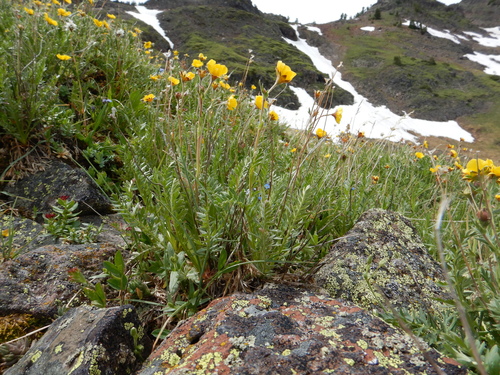


Ross' Avens
geum rossii
Ross' Avens (Geum rossii) is a resilient, low-growing alpine perennial that paints high-elevation meadows and rocky ridges with bursts of cheerful yellow. Thriving in the harsh, wind-swept tundras of North America and eastern Asia, this tenacious member of the rose family is a true survivor. It has adapted beautifully to some of the most extreme environments on Earth, where freezing temperatures and intense solar radiation are daily challenges. In addition to its ecological role as an early-season resource for pollinators, Ross' Avens plays a dramatic visual role in alpine landscapes. As summer transitions to autumn, its dense, divided green leaves undergo a stunning metamorphosis, turning entire mountainsides into vibrant carpets of brilliant crimson and copper. It is a favorite sight for high-altitude hikers and nature enthusiasts.
Habitat: Found in high-elevation alpine tundra, rocky mountain slopes, gravelly screes, and fellfields above the timberline.
This plant forms low-growing, cushion-like clumps typically standing 10 to 30 centimeters tall. It features bright yellow, buttercup-like flowers that are 1.5 to 2.5 centimeters wide, each displaying five rounded petals surrounding a dense cluster of golden stamens. The leaves are deeply divided and pinnate, resembling small, intricate ferns, and form a lush green base during the spring and summer before transforming into a striking, deep red color in the autumn.
Category
PlantsRarity
Common
Danger
1/5 · Very low
Snaps
Be the first to snap!
Despite the freezing winds of alpine ridges, the saucer-shaped flowers of Ross' Avens act like miniature satellite dishes, focusing solar heat onto their reproductive organs to attract pollinators.
Individual clumps of Ross' Avens can survive for over a decade in some of the harshest, most nutrient-poor soils on the planet.
Its spectacular autumn transformation turns vast green tundra landscapes into striking fields of crimson, visible from miles away.
Accumulates high concentrations of soluble sugars in its cellular fluid to prevent ice crystals from damaging its tissues during sudden summer freezes.
Produces high levels of red anthocyanin pigments in autumn, which protect the leaf cells from intense high-altitude sunlight while the plant prepares for winter dormancy.
Utilizes a tough, creeping underground rhizome system that anchors the plant firmly in unstable, shifting scree slopes and captures scarce moisture.
As a photosynthetic autotroph, Ross' Avens converts sunlight, carbon dioxide, and water into sugars to fuel its growth while absorbing water and mineral nutrients through its root system.
Ochotona princeps
The American Pika harvests the leaves and flowers of Ross' Avens to store in its haypiles as a vital winter food source.
Bombus balteatus
The Alpine Bumblebee visits the yellow blossoms to collect nectar and pollen, serving as a primary pollinator.

Ovis canadensis
Bighorn Sheep graze on the nutrient-rich summer foliage of Ross' Avens in alpine meadows.
No trait badges are assigned for this object yet.
No aliases listed yet.
Collections for this object will appear here as more themes are added.
Danger
1/5 · Very low
No special safety notes yet.
Start with the whole plant, then compare leaf arrangement, leaf edges, stems and any flowers or fruit. Opposite leaves grow in pairs; alternate leaves come one at a time along the stem. These details tell you far more together than a single green leaf does. Plant Identifier: upload a photo and compare the visible details.
10-30 cm
5-15 years
As a photosynthetic autotroph, Ross' Avens converts sunlight, carbon dioxide, and water into sugars to fuel its growth while absorbing water and mineral nutrients through its root system.
Found in high-elevation alpine tundra, rocky mountain slopes, gravelly screes, and fellfields above the timberline.
Zoom in to split clusters and explore where this object has been snapped.
Recent snaps will appear here as new observations are added.
Take the discovery with you
Snap it with Snappit to identify it, learn what makes it special, and add the discovery to your collection.


















