





rough goose neck moss
Hylocomiadelphus triquetrus
Rough goose neck moss is a soft, green plant that grows on the ground and on tree trunks. It looks like little green pillows and helps keep the forest moist and cool.
Habitat: Forests
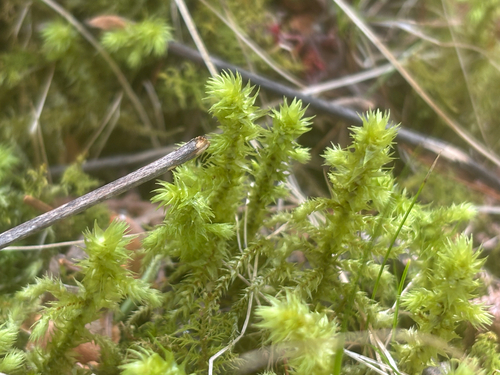
The rough goose neck moss has stiff, triangular stems that create a rugged, matted appearance. Its leaves are sharply pointed, giving it a somewhat prickly feel, and its color ranges from vibrant green to yellowish-green. It forms dense, carpet-like patches.
Category
PlantsRarity
Common
Danger
1/5 · Very low
Snaps
2
Its stiff, pointy leaves make it feel surprisingly rough and prickly, not soft!
This moss grows upwards in distinct layers, almost like a miniature, living staircase!
This moss helps young tree seedlings sprout by making a moist, protective bed.
When it dries out, its stems curl into a "goose neck" shape to protect itself!
Rough goose neck moss can dry out completely, then "wake up" and turn green again when water returns!
This moss forms dense, interlocking mats that help hold soil in place, stopping it from washing away.
Its complex, branched stems create miniature forests, providing important shelter for tiny insects and other small creatures.
Collembola albifrons
Tiny insects hide and forage within its dense mats.
Peltigera canina
Often grows alongside the moss on forest floors.
Sorex cinereus
Shrews use moss for nesting material and cover.
This trait describes a symbiotic relationship between a fungus and the roots of a plant, benefiting both organisms.
This trait characterizes plants lacking specialized vascular tissues (xylem and phloem) for transporting water and nutrients.
Shade tolerant plants are adapted to grow and thrive in areas with low light levels, requiring less direct sunlight.
Spore-producing organisms reproduce by releasing small, often single-celled, reproductive units called spores.

Describes organisms that break down dead organic material, recycling nutrients back into the ecosystem.

Forest habitats are terrestrial environments dominated by dense tree cover, supporting a high diversity of plant and animal life.
No aliases listed yet.
Danger
1/5 · Very low
It's safe to touch, but remember to be gentle with plants.
The easiest way to identify rough goose neck moss is to use the Snappit nature identifier app.
5-20 cm
10-50 cm
No
None
Perennial
Forests
Zoom in to split clusters and explore where this object has been snapped.
May 5, 2026
Norway Historic DistrictPhoto attribution
(c) JSReiff, some rights reserved (CC BY)
License: CC BY 4.0 ↗
Image may be shown cropped inside the card frame.

Maine, US
You might spot Northern Whitecedar and Eastern White Pine.
View guide →

Vermont, US
You might spot Common Eastern Bumble Bee and Red Trillium.
View guide →

British Columbia, CA
You might spot Lettuce Lichen and Giant White Fawn Lily.
View guide →
Take the discovery with you
Snap it with Snappit to identify it, learn what makes it special, and add the discovery to your collection.








.jpg&width=800)



_001.jpg&width=800)



