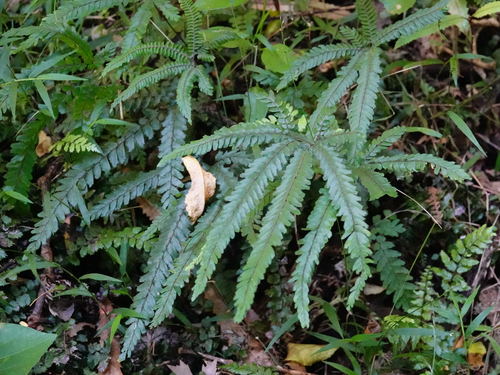


Rough Maidenhair Fern
adiantum hispidulum
The Rough Maidenhair Fern (Adiantum hispidulum) is a charming and resilient fern species admired for its delicate appearance and textured fronds. Native to a wide range of tropical and subtropical regions, it brings an elegant, verdant touch to its natural habitats, thriving in shaded, moist environments. Unlike many ferns, its 'rough' designation comes from the fine, stiff hairs that give its fronds a distinctive, slightly bristly feel. This plant plays an important role in its ecosystem by contributing to the understory vegetation, stabilizing soil, and providing microhabitats for small invertebrates. Its ability to colonize rocky crevices and banks makes it a pioneer species in certain niches, demonstrating its adaptability and endurance.
Habitat: Found in damp, shaded areas within rainforests, open forests, woodlands, and rocky crevices, often on banks or along watercourses.
This fern typically grows to a height of 15 to 45 centimeters, featuring dark, wiry stipes (stems) that are often reddish-brown to black and contrast beautifully with its green fronds. The fronds are somewhat triangular in overall shape and are highly divided, composed of numerous small, fan-shaped to rhomboid pinnae. A key identifier is the presence of short, stiff hairs on both sides of the pinnae, giving them a subtly rough or bristly texture. The sori, where spores are produced, are found along the reflexed margins of the pinnae on the underside.
Category
PlantsRarity
Common
Danger
1/5 · Very low
Snaps
Be the first to snap!
Its delicate, dark, wiry stems, often compared to human hair, are what give the genus 'Adiantum' its common name 'maidenhair fern'.
The species name 'hispidulum' is Latin for 'minutely bristly' or 'hairy', referring to the small, stiff hairs found on its fronds.
Unlike most ferns that have kidney-shaped indusia (protective flap over sori), maidenhair ferns have false indusia formed by the reflexed, or folded-over, leaf margins.
Like all ferns, the Rough Maidenhair reproduces via spores, which are microscopic and can be carried by wind over long distances, allowing for effective colonization of new suitable habitats.
It possesses creeping rhizomes beneath the soil surface, enabling it to spread vegetatively and form dense colonies, enhancing its resilience and ability to recover from disturbances.
While preferring moisture, Adiantum hispidulum exhibits a relatively higher tolerance to drier conditions compared to many other maidenhair ferns, allowing it to persist in areas with intermittent moisture.
As a photosynthetic organism, the Rough Maidenhair Fern produces its own food by converting light energy into chemical energy. It absorbs water and essential nutrients from the soil, and carbon dioxide from the atmosphere.
Glomeromycota species
Fungi associated with roots that enhance nutrient uptake, especially phosphorus.
Deroceras reticulatum
Small invertebrates that may graze on fern fronds, especially young ones.
Blechnum spp.
Other shade-loving plants competing for light and soil resources in the understory.

Homo sapiens
Occasionally grown in gardens and as houseplants due to its attractive foliage and relative hardiness.
No trait badges are assigned for this object yet.
No aliases listed yet.
Collections for this object will appear here as more themes are added.
Danger
1/5 · Very low
No special safety notes yet.
Compare frond shape, how the leaflets are arranged, the stalk, and any spore clusters you can see. A single detached leaflet often hides the plant's overall growth pattern. Fern Identifier: upload a photo and compare the visible details.
15-45 cm
0.005-0.05 kg
5-15 years
As a photosynthetic organism, the Rough Maidenhair Fern produces its own food by converting light energy into chemical energy. It absorbs water and essential nutrients from the soil, and carbon dioxide from the atmosphere.
Found in damp, shaded areas within rainforests, open forests, woodlands, and rocky crevices, often on banks or along watercourses.
Photosynthesis
Zoom in to split clusters and explore where this object has been snapped.
Recent snaps will appear here as new observations are added.
Take the discovery with you
Snap it with Snappit to identify it, learn what makes it special, and add the discovery to your collection.