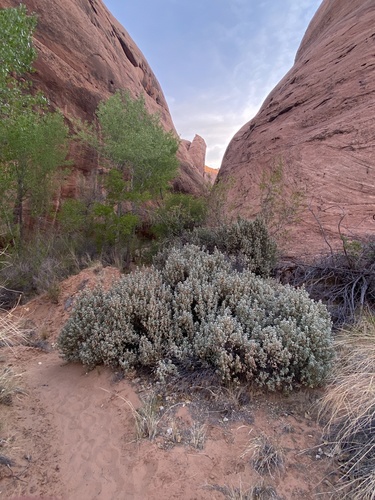


Roundleaf Buffaloberry
shepherdia rotundifolia
The Roundleaf Buffaloberry is an exceptional evergreen shrub that brings a splash of shimmering silver to the rugged landscapes of the Colorado Plateau. Perfectly adapted to the arid, sun-baked environments of the American Southwest, this hardy plant thrives in sandy soils and sandstone crevices where few other species can survive. It plays a vital role in its ecosystem by stabilizing soils and providing shelter and sustenance for local wildlife. Historically, Native American tribes utilized this resilient plant, using its bitter but edible berries for food and various parts of the shrub for traditional crafts. Today, it stands as a symbol of desert survival, mesmerizing hikers and nature spotters with its unique, coin-shaped foliage that sparkles under the intense desert sun.
Habitat: Typically found clinging to sandstone cliffs, sandy slopes, and rocky ledges within desert shrublands and pinyon-juniper woodlands.
This plant is a compact, rounded shrub typically standing 50 to 200 centimeters tall. It is easily identified by its thick, leathery, opposite leaves which are nearly perfectly circular to broadly oval in shape. Both the stems and leaves are covered in a dense coat of scurfy, star-shaped silver hairs that give the entire plant a distinctive pale, dusty-green or silvery-blue appearance. The leaf undersides often feature a warmer, yellowish or rusty-brown hue. During early spring, it produces tiny, inconspicuous yellow-green flowers tucked in the leaf axils, which eventually develop into small, silver-scurfy, berry-like drupels.
Category
PlantsRarity
Common
Danger
1/5 · Very low
Snaps
Be the first to snap!
Although edible, the berries contain saponins which make them taste soapy and extremely bitter unless cooked or mixed with sugar.
The microscopic star-shaped scales covering the leaves act like tiny mirrors, giving the plant a metallic, glittering appearance in direct sunlight.
The specific epithet 'rotundifolia' literally translates to 'round-leafed', highlighting its distinctive coin-shaped foliage.
Partners with symbiotic Frankia bacteria in its roots to extract and convert atmospheric nitrogen, allowing it to flourish in nutrient-depleted desert soils.
Possesses dense, star-like leaf hairs that reflect intense desert sunlight, reducing leaf temperature and limiting vital water loss through transpiration.
Employs an extensive, tenacious root system that anchors firmly in sandstone cracks to tap into deep, scarce water reserves.
As a photoautotroph, this plant manufactures its own organic compounds from sunlight, water, and carbon dioxide through photosynthesis.
Frankia actinomycete
Establishes a mutualistic root-nodule relationship to fix nitrogen in barren soils.

Odocoileus hemionus
Feeds on the tough, evergreen leaves and twigs during harsh winter months.

Corvus corax
Consumes the dry, scurfy berries and helps disperse the seeds across desert habitats.
No trait badges are assigned for this object yet.
No aliases listed yet.
Collections for this object will appear here as more themes are added.
Danger
1/5 · Very low
No special safety notes yet.
Compare how the fruit is clustered, the leaves and their arrangement, the stems and any thorns. Red, blue and black fruits grow on lots of unrelated plants, and the same color can show up on both edible and poisonous species. Berry Identifier: upload a photo and compare the visible details.
50-200 cm
20-50 years
As a photoautotroph, this plant manufactures its own organic compounds from sunlight, water, and carbon dioxide through photosynthesis.
Typically found clinging to sandstone cliffs, sandy slopes, and rocky ledges within desert shrublands and pinyon-juniper woodlands.
Zoom in to split clusters and explore where this object has been snapped.
Recent snaps will appear here as new observations are added.
Take the discovery with you
Snap it with Snappit to identify it, learn what makes it special, and add the discovery to your collection.